Welcome to the Social Media Research @ JNU Blog!!! This Blog is created to share information, knowledge networking and debating on the issues related to Social Media Studies and Advanced Social Media Research. Topics to be covered in this blog are (but not limited to): Mass Media, Social Media, New Media, Broadcasting, Print Media, Educational Media, Journalism, Mass Communication, Development Communication, Media Law, Media Literacy, ICT for Development and other relevant areas.
Thursday, April 21, 2022
Fwd: Digitalization of Healthcare System in India—A Perspective and PESTLE Analysis
Tuesday, April 19, 2022
New SSM Article "Digital health for all: The turn to digitized healthcare in India" by Marine Al Dahdah and Rajiv K.Mishra
by Marine Al Dahdah and Rajiv K.Mishra
Social Science & Medicine, 2022, DOI: 10.1016/j.socscimed.2022.114968, Download
Highlights
- Biometric-based identification is a key enabler for accessing healthcare in India.
- The Digitized welfare process has direct consequences for life and limb.
- Accessing UHC through biometrics is creating new forms of exploitation and abuse.
Keywords: Digital Access, Healthcare, RSBY, India, Jharkhand, Chhattisgarh
Special Note by Rajiv: I sincerely thank Prof. V. V. Krishna, who has contributed immensely to shaping me as an STS researcher. Moreover, had it not been for his involvement with the French STS research network, we would have never been able to start the Digital Studies Group from CSSP, JNU, and the research collaborations and publications we have done together. The group has expanded into a global network of researchers across four continents.
Monday, April 18, 2022
R&D Management - Call for Papers "R&D Management under disruption and uncertainty"
Background: R&D management under disruption is important for both leading firms in developed countries (Christensen, 1997) and latecomer firms in emerging economies (Malerba and Lee, 2021). To embrace the disruption opportunity (Gilbert, 2003), firms must make smart R&D decisions under uncertainty.....
In summary, different types of disruption might break the "structural inertia" and "equilibrium" of an existing innovation system (Narula, 2002, 2003), bringing both challenges and opportunities for different actors' R&D activities. Apparently, different actors within an innovation system might respond to such uncertainties differently. For example, some firms might adopt proactive strategies to shape the innovation system in which they operate (i.e. 'voice' strategy), whereas other firms might adopt reactive strategies to either ignore the changes in the focal innovation system (i.e. 'loyalty' strategy) or exit the current innovation system (i.e. 'exit' strategy) (Hirschman, 1970). Some scholars (e.g., Millar et al., 2018) have started to discuss the challenges and opportunities brought by the disruptions and uncertainty in this era. Although there has been some progress along this line of thinking (Frynas et al., 2018; Kim et al., 2018; Schoemaker et al., 2018), we think the impact of disruptions and uncertainty in this era goes beyond R&D management within companies. It requires systemic thinking at the macro, meso, and micro levels from academic scholars, industry practitioners, and policymakers.
The main goal of the special issue: The main goal of this special issue is to call for more research on R&D management under disruption and uncertainty. We welcome submissions that address the intersection of disruption, uncertainty, and R&D management. For example, papers can address how different types of disruption/uncertainty affect organizations' R&D management (disruption/uncertainty as "antecedent") or examine how different R&D management practices can generate or reduce a specific type of disruption/uncertainty (disruption/uncertainty as "consequence"). We are open to different methodological approaches, such as conceptual, qualitative, and quantitative research.
Potential research questions:
- Macro-level
- What role do disruption and uncertainty play in innovation systems?
- When and how do disruption and uncertainty in innovation systems affect activities and interactions of different actors, such as firm R&D, university R&D, and university-industry collaborations?
- How can different countries build open national innovation systems (Fu, 2015) in an era of disruption?
- Will disruption and uncertainty affect international research collaborations (Chen et al., 2019; Fu et al., 2021)? What policies are effective for enhancing international research collaborations under disruption and uncertainty?
- How can we build more inclusive innovation systems to guide the R&D of emerging technologies (e.g. AI)?
- What types of disruption can open "windows of opportunity" (Lee & Malerba, 2017) for developing countries? How can developing countries seize such "windows of opportunity"?
- Meso-level
- How do different types of disruption affect technological trajectories in different sectors?
- How do different types of disruption affect international linkages and sectoral dynamics in different sectors?
- When and how do disruption and uncertainty reshape global value chains?
- Why do different sectors differ in the patterns of innovative activities under uncertainty?
- How do different regional innovation systems differ in terms of capabilities to handle disruption and uncertainty?
- What are the impacts of different types of disruption on industrial leadership and latecomers' catching-up in different sectors?
- Micro-level
- How do different types of disruption and related uncertainties affect firms' R&D decisions and R&D activities?
- How can different actors of innovation systems (e.g. government, firm, university, research institute) manage their R&D activities under disruption and uncertainty?
- Why do different types of firms and non-firm actors in innovation systems respond to disruption and uncertainty differently (e.g. reactive responses versus proactive responses)?
- How do disruption and uncertainty affect firms' R&D strategy, management practices, investment behaviours, internationalization, or alliances/collaboration strategies (Narula and Martinez-Noya, 2015)?
- When and how do disruption and uncertainty affect open innovation at the firm level?
- When and how do disruption and uncertainty affect entrepreneurship at the "base of the pyramid" (Fu et al., 2022) and innovation activities in low-income countries (Fu, 2020)?
- First date of the open call: March 2022
- Online submission window: December 1, 2022 – January 31, 2023
- Expected publication date: First half of 2024
We will offer opportunities for authors to engage with the editorial team prior to submitting a manuscript. We will organize online webinars, or panels at the R&D Management annual conference and the GLOBELICS annual conference, to advertise the special issue and encourage submissions.
- R&R workshop: We plan to organize an R&R workshop to help authors, who receive the first round Revise and Resubmit, further improve their papers.
- Post-publication panel: We will organize a post-publication panel at the AOM annual meeting to promote the selected papers in the special issue. We will also promote the special issue through online platforms such as Twitter, Facebook, and other social media.
Call for Chapter Proposals: Archiving Activism in the Digital Age | Abstract submission deadline: 15 May 2022
Contributions may include, but are not limited to, these topics:
- Archiving activism and activist archiving in the digital age: professional and activist epistemologies;
- archiving digital repertoires of protest;
- the legacy of past social movements: digitization, digital remediations and reuses for mobilization in the present;
- how the digital drives memory- and oblivion-making in archiving processes: algorithms and digital affordances;
- methodologies in digital humanities: opportunities and challenges offered by the digital for the study of the cultural memories of protest (distant reading, etc…)
- conditions of circulation and availability of archival material in the digital age;
- digital archives as social spaces for activism;
- new forms of digital or web-based grassroots or self-curated movement archives;
- the effect of copyright and privacy legislations in archiving activism and memory work;
- use of archives for digital curations and story-telling
- Please submit a title and an abstract of around 500 words with a short bio (80 words) to: a.rigney@uu.nl and d.salerno@uu.nl. Abstracts should reference up to 10 works in the relevant literature and six keywords.
- Notification of abstract acceptance: June 1, 2022
- Full paper submission: October 14, 2022 (between 4500 and 7500 words, including footnotes and bibliography)
- The volume will be published open access.
- Ann Rigney is professor of Comparative Literature at Utrecht University, and PI of the ERC-funded project "Remembering Activism".
- Daniele Salerno is Marie-Curie post-doctoral fellow at Utrecht University, and PI of the project "Cultural Memory in LGBT Activism".
References
- Bolter, J. David, and Richard Grusin. 1999. Remediation: Understanding New Media. Cambridge (Mass.): MIT Press.
- Caswell, Michelle. 2021. Urgent Archives: Enacting Liberatory Memory Work. London-New York: Routledge.
- Della Ratta, Donatella, Kay Dickinson, and Sune Haugbolle, eds. 2020. The Arab Archive: Mediated Memories and Digital Flows. Amsterdam: Institute of Network Cultures.
- Erll, Astrid, and Ann Rigney, eds. 2009. Mediation, Remediation, and the Dynamics of Cultural Memory. Berlin: de Gruyter.
- Flinn, Andrew, and Ben Alexander. 2015. "'Humanizing an Inevitability Political Craft': Introduction to the Special Issue on Archiving Activism and Activist Archiving." Archival Science 15(4): 329–335.
- Foucault, Michel. 1969. Archaeology of Knowledge. London-New York: Routledge.
- Hoskins, Andrew, ed. 2017. Digital Memory Studies: Media Pasts in Transition. London-New York: Routledge.
- Latour, Bruno. 2005. Reassembling the Social: An Introduction to Actor-Network-Theory. Oxford: Oxford University Press.
- Merrill, Samuel, Emily Keightley, and Priska Daphi, eds. 2020. Social Movements, Cultural Memory and Digital Media: Mobilising Mediated Remembrance. Cham: Palgrave.
- Rigney, Ann. 2018. "Remembering Hope: Transnational Activism beyond the Traumatic." Memory Studies 11(3):368–80.
- Sheffield, Rebecka Taves. 2020. Documenting rebellions: a study of four lesbian and gay archives in queer times. Sacramento, CA: Litwin Books.
- Tilly, Charles. 2006. Regimes and Repertoires. Chicago: University of Chicago Press.
- Treré, Emiliano. 2018. Hybrid Media Activism: Ecologies, Imaginaries, Algorithms. London-New York: Routledge.
Call for Applications: 15th Globelics Academy PhD School on Innovation and Development | Deadline approaching
15 - 26 August 2022
Tampere, Finland
The Globelics Academy PhD school consists of a two-weeks event for young scholars in the fields of innovation studies.
The aim of the Globelics Academy PhD School on Innovation and Development (GA) is to support the training of PhD-students writing theses on issues related to innovation systems, economics of innovation, and technological change.
The Academy brings together frontier researchers within innovation studies with PhD-students from around the world, both to inspire and qualify their work and to help them to join high-quality research networks. It consists of a two-weeks event with a range of activities, such as (1) lectures from senior scholars from the Globelics community (https://www.globelics.org/), (2) young scholars presenting a PhD chapter/paper and receiving feedback from mentors and colleagues. Besides the academic activities, the academy offers (3) the opportunity to engage with the actors in the local ecosystem of innovation (start-ups, entrepreneurs and policy makers). The GA is in its 15th edition, and it consists of a unique chance to engage with a vibrant community, composed by other young scholars, early career researchers, mentors and senior established scholars in the field of innovation studies. The 15th version of the Globelics PhD Academy (GA) will take place in Tampere, Finland, from the 15th – 26th of August 2022. Please submit your application by 24 April 2022.
Chris Freeman’s Centenary Essay Competition 2022 | Deadline extended
- Description: The essay competition seeks to incentivise the diffusion of Chris Freeman's ideas among PhD students as well as early-career researchers in the Global North and South. This competition calls for contributions in the following seven themes: (1) Development, (2) Growth, (3) Systems of innovation, (4) Long Waves (5) Science Policy, (6) Science, Society and Nature and (7) Innovation management. A list of readings is found on the webpage www.freemanchris.org/publications/. A Freeman Reader with those same themes is being prepared for publication.
- Entry Requirements: Entry is open to PhD students and early career researchers (within three years of completing a PhD). Each essay should address only one of the themes outlined above and must not exceed 1,500 words (excluding tables, footnotes, and bibliography). Please, submit your essay, saved in PDF format, indicating the theme you are addressing and the final word count through the submission system available at: https://www.conftool.net/chris-freeman-essay/. Also note that the essays will be subject to a double-blind review process. Hence, no information about the author should be included in the essay. A failure to comply with this requirement will lead to disqualifying the submission.
- Prizes: A prize may be given for the best essay under each one of the seven themes, including a prize for the best essay overall. The candidate who submits the best essay overall will be awarded €400. The winner of each of the other six categories will be awarded €100. The winning essay (and the runners up) will be published in a blog on the Chris Freeman website and widely announced on social media.
- Criteria: The essays will be judged on: (a) the level of knowledge and understanding of Chris Freeman's ideas on the theme chosen, (b) the ability to apply Freeman's ideas to contemporary societal challenges, (c) the originality of the content, (d) the quality of the argumentation, (e) the structure and (f) the writing style.
- Key Dates
- Submission deadline: 15 May 2022 (extended)
- Announcement of results and award ceremony: TBA
- Questions may be sent to the following email address: chris.freeman.essay@gmail.com. Further Details: https://www.globelics.org/chris-freemans-centenary-essay-competition/
Thursday, April 7, 2022
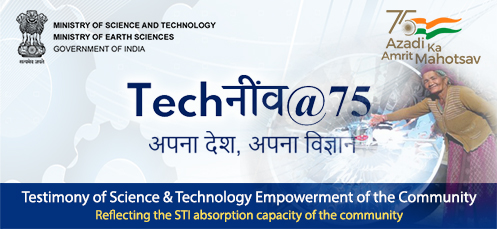
Invitation to Day 12 of Techneev@75 | 8th April 2022 at 2 PM
|
|
|
|
|
|
Website: https://www.indiascienceandtechnology.gov.in/
Email ID: istiportal@vigyanprasar.gov.in
Facebook: https://www.facebook.com/ISTIPortal/
YouTube: https://www.youtube.com/c/IndiaScienceTechnologyandInnovationISTI
Twitter: https://twitter.com/istiportal
LinkedIn: https://in.linkedin.com/in/ISTIPortal