Thursday, April 30, 2015

New book from CSSP "Diaspora, Culture and Identity: Asian Indians in America" by Poonam Bala

Diaspora, Culture and Identity: Asian Indians in America
by Poonam Bala
Rawat Publications, 2015, 152 pages, ISBN: 9788131607183

About the Book
The recent spur in the literature on various aspects of the Asian community in general and South Asians in particular, has focused largely on either the changing status of Indian women, or on the social and cultural transformations they have undergone as "immigrants" from a vastly different culture, or on a feminist perspective of Indian women in America. Most recently, studies have alluded to the South Asian immigration in the broader context of Asian immigration to the United States. Some studies have focused on the linguistic, cultural, and religious ideologies in view of the 'adopted' socio-cultural values amongst the Hindu diaspora across different cultures. In as much as above perspectives provide answers to various issues about the Indian diaspora, they do not account for issues related to identity, social and cultural adjustments, and perception of parent cultures by second and third generations.
This book is written in the belief that there exists no single work that documents the various issues of the Indian diaspora through their own voices, and through successive generations in Ohio. It is hoped that the proposed work will provide an insight into various issues that have neither been voiced nor documented, yet have played a significant role in the lives of the Asian community in America. The book explores the patterns and the reasons for cultural 'shifts' amongst the Asian Indian community in Ohio. It also provides a platform for further studies and useful comparisons with immigrants from other countries who went through similar trajectories of cultural encounters and changes, much like their South Asian counterparts - trajectories that enabled perpetuation of social and cultural values and a distinct identity necessary for cultural assimilation following their move.

Chapters
1. Reflections on Migration of Asian Indians: An Introduction
2 Travels Across: Asian Indians in America
3 Breaking the Silence: Nostalgia and Memories
4 'New' Identity and 'Old' Institutions: Voices and Viewpoints
5 Understanding the Trajectories of Asian Indians: Concluding Reflections

About the Author
Poonam Bala is currently a Visiting Professor at the Centre for Studies in Science Policy (School of Social Sciences) at Jawaharlal Nehru University, New Delhi and an affiliated Visiting Scholar at Cleveland State University. She is also the founding member of the Asian Indian Heritage Project in Ohio and has held various national and international scholarships/ fellowships besides holding teaching positions at universities in India, Canada and the US. With a range of research interests and expertise in policies and health/medicine, alternative medicine, history of medicine and society, race and health, she has authored and edited several books and articles. Her select publications include Imperialism and Medicine in Bengal: A Socio-Historical Perspective; Medicine and Medical Policies in India; Biomedicine as a Contested Site: Some Revelations in Imperial Contexts; Contesting Colonial Authority: Medicine and Indigenous Responses in 19th and 20th-century India and Medicine and Colonialism: Historical Perspectives in India and South Africa, with a new project on comparative themes in medicine, race and gender under the British empire.

Further Details: http://www.goodreads.com/book/show/25460521-diaspora-culture-and-identity

Wednesday, April 29, 2015

Journal of Scientometric Research, 4(1) Issue is now online

[Apologies for Cross-Posting]


CoverpageTable of Contents - Journal of Scientometric Research (J Sci Res)
2015 | January-April | Volume 4 | Issue 1


RESEARCH ARTICLES

The growth of Brazilian metrics literature [pg. 1]
Rubén Urbizagástegui Alvarado, Cristina Restrepo Arango
[ABSTRACT]   [HTML FULL TEXT]   [PDF]   [Mobile HTML Full text ]   [EPub]

Reporting quality of statistics in Indian journals: Analysis of articles over a period of two years [pg. 10]
Kannan Sridharan, S Gowri
[ABSTRACT]   [HTML FULL TEXT]   [PDF]   [Mobile HTML Full text ]   [EPub]

Bibliometric observation of publication output of university teachers: A study with special reference to physics [pg. 14]
S Aswathy, A Gopikuttan
[ABSTRACT]   [HTML FULL TEXT]   [PDF]   [Mobile HTML Full text ]   [EPub]

A bibliometric analysis of linguistics in web of science [pg. 20]
Engin Arik
[ABSTRACT]   [HTML FULL TEXT]   [PDF]   [Mobile HTML Full text ]   [EPub]

Ethnobotany genomics research: Status and future prospects [pg. 29]
Franky Varah, Pranav N Desai
[ABSTRACT]   [HTML FULL TEXT]   [PDF]   [Mobile HTML Full text ]   [EPub]

BOOK REVIEW

Beyond bibliometrics: Harnessing multidimensional indicators of scholarly impact [pg. 40]
Robin Haunschild
[ABSTRACT]   [HTML FULL TEXT]   [PDF]   [Mobile HTML Full text ]   [EPub]

RESEARCH IN PROGRESS

Citation pattern of newsworthy research articles [pg. 42]
Manjari Manisha, G Mahesh
[ABSTRACT]   [HTML FULL TEXT]   [PDF]   [Mobile HTML Full text ]   [EPub]

Audio Recording - JNU panel discussion on Science of the Past: Reason, Method and History held on 29 April 2015


Centre for Historical Studies, JNU, India

organized a panel discussion on

Science of the Past: Reason, Method and History

(covering History of Aviation Technologies in India, Vimana Sastra, etc.)

by 
Hanasoge S Mukunda
Former Professor, Aerospace Engineering Department, IISc, Bengaluru
Currently Advisor to Advanced Bioresidue Energy Technology Society at IISc, Bengaluru

Discussant: Dhruv Raina, Professor, ZHCES, SSS, JNU

CHS, Room #326, SSS-3, JNU

 on 29 April 2015

Tuesday, April 28, 2015

Call for Essays: Studying Internet in India

Call for Essays: Studying Internet in India
As Internet makes itself comfortable amidst everyday lives in India, it becomes everywhere and everyware, it comes in 40 MBPS Unlimited and in chhota recharges – and even in zero flavour – the Researchers at Work (RAW) programme at the Centre for Internet and Society invites abstracts for essays that explore what it means to study Internet(s) in India today.
We are interested in the many experiences of Internet(s) in India; its histories and archaeologies; how we use it to read, write, create, relate, learn, and share; the data that is produced, and the data that is consumed; the spaces that are created, and the spaces that are inhabited; the forms that political expressions take on the Web; and of course, where and how should one be studying Internet(s) in India?
This call is for researchers, workers, and others interested in closely – or from a distance – commenting on these topics and questions.
Please send abstracts (200 words) to raw@cis-india.org by Sunday, April 26, 2015. The subject of the email should be 'Studying Internet in India.'
We will select up to 10 abstracts and announce them on Friday, May 01, 2015.
The selected authors will be asked to submit the final longform essay (2,500-3,000 words) by Sunday, May 31, 2015. The final essays will be published on the RAW Blog. The authors will be offered an honourarium of Rs. 5,000.
We understand that not all essays can be measured in words. The authors are very much welcome to work with text, images, sounds, videos, code, and other mediatic forms that the Internet offers. We will not be running a Word Count on the final 'essay.' The basic requirement is that the 'essay' must offer an argument – through text, or otherwise.

Further Details: http://cis-india.org/raw/call-for-essays-studying-internet-in-india


Vacancy for Policy Associate (Internet Governance)
The Centre for Internet and Society is seeking an individual with a strong background in legal research and policy work to be part of our Internet governance (IG) programme. This position deals with freedom of expression and Internet governance at both the national and international levels.
Note:This is a full-time position, based out of Bangalore (strongly preferred) or New Delhi. There is currently one vacancy for this post.
The candidate must have the following skills:
  •     Knowledge of Indian and international law on freedom of expression and strong background in Internet governance.
  •     Demonstrable research skills.
  •     Strong communication skills and media-savvy, with the ability to convey complex legal issues clearly to a general audience.
  •     Public-speaking skills, and willingness to travel both nationally and internationally.
  •     Ability to lead the programme in setting the goals for the programme, as well as the strategy.
  •     Ability to work independently.
Preferred characteristics:
  •     Educational background in public policy or law.
  •     A pre-existing network of contacts with policymakers, media, etc.
  •     Experience in working with the government.
To apply, please send your résumé to Pranesh Prakash (pranesh@cis-india.org) and Sunil Abraham (sunil@cis-india.org) with two writing samples related to freedom of expression and Internet governance of which at least one demonstrates your analytic skills, and one that shows your ability to simplify complex policy issues. Governmental rules prohibit us from hiring foreigners for this post. The deadline for applications is Sunday, May 10, 2015.

Further Details: http://cis-india.org/jobs/policy-associate-internet-governance

Monday, April 27, 2015

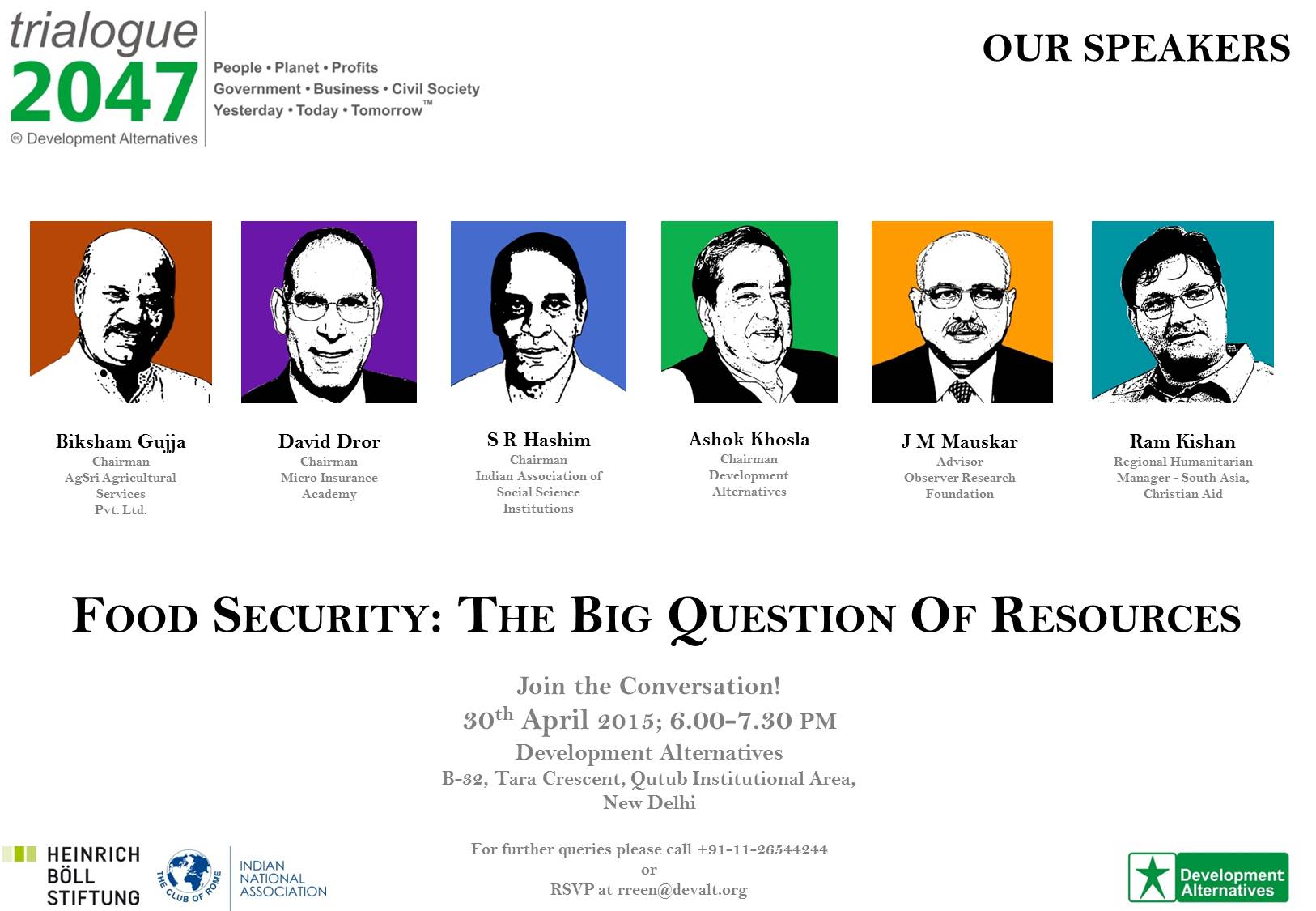
Panel Discussion - Food Security: The Big Question of Resources on April 30, at DA, Qutab Institutional Area, New Delhi

Panel Discussion - Trialogue 2047- Food Security: The Big Question of Resources
Date: April 30, 2015;
Venue: DA, Qutab Institutional Area, New Delhi

RSVP: rreen@devalt.org

Monday, April 20, 2015

3ie invites proposals for systematic reviews that explore the impact of development interventions in the areas of water, sanitation and hygiene; climate change.

Systematic Reviews Call 8
3ie invites proposals for systematic reviews that explore the impact of development interventions in the areas of water, sanitation and hygiene, humanitarian assistance and climate change.
Systematic reviews are an important way of facilitating the widespread use of existing evidence to inform policy and practice. This is the eighth call for proposals under 3ie's systematic reviews programme.
3ie has worked with the Water Supply & Sanitation Collaborative Council (WSSCC), Children's Investment Fund Foundation (CIFF) and the United States Agency for International Development (USAID) Office of Foreign of Disaster Assistance (OFDA) respectively on four questions for this systematic review call.
Proposals must be submitted through 3ie's online grant management system. The deadline for submission of proposals is 12 noon GMT, 22 May 2015.
For more information on this call please read the  Request for Proposals (RFP) (326.2 KB)
In case of queries, please refer to the frequently asked questions (FAQs). Queries that are unanswered can be sent to sr8@3ieimpact.org by 28 April 2015. We will post the questions and answers here within three working days.

At a glance
    There will be one award for each of these questions, but 3ie and its partners may choose to fund fewer reviews if insufficient proposals of adequate quality are received.
    3ie expects to fund grants of up to US$100,000 for each systematic review. But costs may vary depending on a range of factors, including the scope of the review and methods of synthesis employed.
    Only legally registered organisations and consortia of registered organisations, not individuals, may apply.
    Organisations may only submit one proposal per question (but may submit more than one proposal for different questions) and may be included on more than one proposal.
    The lead grant-holding organisation may be located anywhere in the world.
    3ie encourages proposals and research teams from low- and middle-income countries, and requires proposals include researchers from low- and middle-income countries in the study team.

How to apply
To find out more about the application process, visit the How to apply page
For further clarifications, please refer to the frequently asked questions (FAQs).

Systematic review questions
    To what extent has the sanitation and hygiene sub-sector taken into account the life-cycle approach in the design, implementation, maintenance and use of programmes during the Millennium Development Goal (MDG) period (2000-2015)?
    What is the effectiveness of interventions aiming to promote sanitation and hygiene behaviour change in communities?
    What is the comparative efficiency and effectiveness of providing humanitarian non-food item (NFI) in-kind distributions versus cash and vouchers in the immediate aftermath and recovery period following natural disasters and political instability?
    What are the effects of land use change and forestry sector programmes and policies on greenhouse gas emissions and human welfare outcomes? (Evidence gap map and two systematic reviews)

Further Details: http://www.3ieimpact.org/en/funding/systematic-reviews-grants/systematic-reviews-call-8/

Vacancy – ISSC/IDS Post-Doctoral Fellow

Vacancy – ISSC/IDS Post-Doctoral Fellow

published: April 15, 2015

The ISSC and IDS are seeking a motivated and outstanding post-doctoral researcher to do research and help with the editorial coordination of the 2016 World Social Science Report. We are looking for a talented, early career social scientist with long-term experience and an institutional affiliation in a low or middle income country, and a passion for making knowledge work to help solve global challenges.

The regular preparation of a World Social Science Report on global priority topics is a flagship activity of the ISSC. The Council prepared a first WSSR on Knowledge Divides in 2010. It addressed the numerous divides that characterise the production, dissemination and use of social sciences and aspects that fundamentally undermine their ability to respond to global challenges. In 2013 the ISSC co-published with UNESCO and OECD the second World Social Science Report, on Changing Global Environments. The third World Social Science Report will be published in 2016 and focus on the critical issues of inequalities and social justice. It will be co-directed by a senior research team composed of Melissa Leach, John Gaventa, and Patricia Justino from the Institute of Development Studies in Sussex.

Overall purpose of the role

The ISSC and IDS are seeking a motivated and outstanding post-doctoral researcher to do research and help with the editorial coordination of the 2016 WSSR. We are looking for a talented, early career social scientist with long-term experience and an institutional affiliation in a low or middle income country, and a passion for making knowledge work to help solve global challenges.

The selected person will;

  • Carry out research and co-author specific contributions to the WSSR
  • Undertake literature reviews on specific topics
  • Lead coordination of the contributions to some of the WSSR sections

The role is based at IDS (Sussex, UK) and supervised by the WSSR directors there. They will also work in collaboration with the WSSR team based in the Paris secretariat of the ISSC. The selected candidate will be part of the WSSR editorial team.

Main Duties and Responsibilities

The ISSC/IDS Post-Doctoral Fellow, working under the leadership of the WSSR Directors and in close collaboration with the ISSC, will be part of a small editorial collective of 5/6 people.

They will be tasked to

  • Provide written contributions to the WSSR
  • Undertake literature analyses to assist with the different sections of the Report
  • Participate in selecting contributors
  • Coordinating sections (including liaison with the authors) of the report
  • Draft syntheses, introductions, and conclusions
  • Participate in regular editorial meetings
  • Liaise with the reviewers
  • Undertake language editing

They will also liaise on a regular basis with the Paris based ISSC team: the ISSC Report manager, the WSSR Senior Advisor and the Acting Executive Director for Science.

For more information on the role and how to apply, dowload the job description.

Source: www.worldsocialscience.org/2015/04/vacancy-isscids-post-doctoral-fellow/

Saturday, April 18, 2015

Two Weeks Research Methodology Course in Asian Studies; MAKAIAS, Kolkata; 15 June – 2 July

Two Weeks Research Methodology Course in Asian Studies

Venue: Maulana Abul Kalam Azad Institute of Asian Studies (MAKAIAS), Kolkata

Dates: June 15 – July 2, 2015


MAKAIAS (An Autonomous Body under the Ministry of Culture, Govt. of India) invites applications are for Two Weeks Research Methodology Course in Asian Studies to be held at MAKAIAS, Kolkata from June 15 - July 2, 2015. Interested candidates (MPhil final year/PhD/Research Associates) are requested to send their applications in the prescribed format downloadable from MAKAIAS website (www.makaias.gov.in).

Last date of receiving applications: May 11, 2015.

CSDS Delhi invites applications for its two-month Course on "Researching the Contemporary"

Course on "Researching the Contemporary" 2015

The Centre for the Study of Developing Societies invites applications for its two-month Course on "Researching the Contemporary". This cross-disciplinary Course will critically examine the formation of the contemporary and its multiple histories, ideologies, forms and affects.  The three courses offered will enable participants to familiarize themselves with concepts, theories and methods that help analyse the contemporary.  These include:

Media & Materiality: The Digital Sensorium

The 'digital' has become the lens through which life is increasingly being framed: the personal and the political, money and consumption, memory and distraction: the list is endless. By mobilising media and cultural theory, this course seeks to understand the place of the digital within a larger debate on materiality. Themes include the media event, circulation, memory, the political and violence.

Course Instructor: Ravi Sundaram

The Work of Theory: Thinking Across Traditions

The term 'theory' immediately brings to mind names such as Plato, Kant, Hegel, Husserl, Marx and so on.  That is, theory appears as a particular body of philosophical thought coming to us from Europe and globally relevant in its scope. To us theory therefore comes as a given body of knowledge, as though the essentials have already been settled. In this course, we shift our attention away from western theory as such and ask the prior question – namely, what it is to theorize, what is the work that theorization accomplishes.  We discuss the practice of theorizing by passing through histories and experiences of the global south as well as through alternative theoretical possibilities inherent in other traditions, be they Chinese or Latin American or Arabo-Persian. By using the phrase 'thinking across traditions', we imply that good theory and new theory must shake off its dependence on a single, uncontaminated metaphysical tradition and on a single, dominant historical narrative of modernity.

Course Instructors: Aditya Nigam, Prathama Banerjee, Rakesh Pandey

The Urban Experience

This course shall focus on the making of the urban modern in India and its relationship to theories of global urbanism. Students will be introduced both to the formal dimensions of city making and the unintended consequences of modernist plans and technological transformations. Changing urban spatial imaginaries, as these are inflected by gender, environmental, health and aesthetic concerns, shall be discussed. Attention will be paid to the place of the rural within contemporary urban imaginaries.

Course Instructor: Awadhendra Sharan

This is an intensive Course with compulsory readings and class discussions.  Course materials will be made available. Participants are expected to make presentations and participate in a workshop at the end of the course period.  A participation certificate will be awarded upon successful completion. The Course will be conducted over 8 weeks between 1 July - 31 August 2015.  Classes will be held at CSDS on week-day afternoons, three days a week, from 2.30-5.30 pm.

Applications are invited from M.Phil/Ph.D students as well as independent researchers. As part of your application please submit your C.V. and a 1000-word description of your research question/topic. Selected out-station participants shall be provided with roundtrip travel expenses (3-tier AC) and a stipend of INR 25,000. Please send your applications by email to teaching(at)csds.in

The last date for receiving the applications is 30 April 2015.

Institute of Advanced Study (IAS), Durham University 2016/17 Fellowships


Institute of Advanced Study (IAS), Durham University 2016/17 Fellowships

The Institute of Advanced Study is Durham University's major interdisciplinary research institute, providing a central forum for debate and collaboration across the entire disciplinary spectrum. The Institute seeks to catalyse new thinking on major annual themes by bringing together leading international academics as well as writers, artists and practitioners.
The theme for 2016/17 is 'Scale', interpreted in its broadest sense – scientifically, symbolically, legally, philosophically, literarily, politically, economically, and sociologically. Applications are now invited for up to 20, three-month fellowships (October-December 2016 and January-March 2017), linked to the annual theme. Applicants may be from any academic discipline or professional background involving research, and they may come from anywhere in the world. IAS Fellowships include honorarium, travel, accommodation, subsistence and costs associated with replacement teaching or loss of salary (where appropriate). Further particulars are available from the IAS website www.dur.ac.uk/ias. Further details of the 2016/17
'Scale' theme can also be found here. Informal enquiries with the Directors of the Institute can be made via Linda Crowe, the IAS administrator (Tel: +44 (0) 191 3344686 or email linda.crowe@durham.ac.uk). Closing date for applications is 05 June 2015.
Eligible applicants will be partly funded by the European Union, through the Durham International Fellowships for Research and Enterprise (DIFeREns).

Research
Fellows will contribute to the Institute's annual theme.The Institute provides its Fellows with a setting that offers them time and freedom to think, away from the demands of their everyday professional lives. By recruiting Fellows from all around the world, the IAS also provides an exciting intellectual environment in which thinkers from diverse cultural and disciplinary backgrounds can exchange ideas. Fellows will engage and forge strong links with at least one department at Durham, and be given the opportunity to deliver papers at events organised to coincide with the annual theme.

Theme
The theme for 2016-17 is Scale, interpreted in its broadest sense to be of potential interest to those working in a wide range of disciplines. A number of specific sub-themes have already been identified, including:
    Temporal and Spatial Scales
    Understanding and Representing Scale
    Human Scale
    Scale and Measurement
    Living Scales
    Sustaining Scales
    Governing Scales
    Technological Scale
    Scalability and the effects of Scale
Fellows will be able to engage in these themes or to propose others that are related to the theme of Scale.
Fellowships are available for a 3-month period between October 2016 and March 2017. Applications are considered from researchers or non-academics who have a well-established or strongly emerging international reputation, have made major contributions to their field, and can provide evidence of research leadership and/or public impact. They are expected to have played a significant role in shaping their discipline or field through their outputs, achievements and indicators of esteem. It is expected that the research or professional interests of applicants will complement the 2016/17 annual theme. Up to 20 IAS Fellowships are available each year.

CfPs: 57th ISLE Annual Conference, 10-12 October, Srinagar

Call for Papers

57th ISLE Annual Conference, 10-12 October 2015, Srinagar, India

The 57th Annual Conference of the Indian Society of Labour Economics (ISLE) will be held during 10-12 October, 2015 at Srinagar, Jammu and Kashmir. The Conference is being jointly organised by Central University of Kashmir, Srinagar and S. K. University of Agricultural Sciences and Technology, Kashmir. Professor Ravi Srivastava, Centre for the Study of Regional Development, Jawaharlal Nehru University (JNU), New Delhi is the Conference President.

Conference Themes

1. Unpaid Work

2. Right to Work & Mahatma Gandhi National Rural Employment Guarantee Act

3. Labour and Employment in Manufacturing Sector

Submission of Papers:  Papers along with a summary of 1000 words may be sent to:

Dr. Preet Rustagi, The Hon. Secretary, Indian Society of Labour Economics, NIDM Building, IIPA Campus, I.P. Estate, New Delhi–110002 or emailed to: conference.isle@gmail.com with a copy to 57isleconferencecukmr@gmail.com. Abstracts of papers selected for the Conference will be published and circulated among the Conference participants. Selected revised papers would be considered for publication in the subsequent issues of the Indian Journal of Labour Economics subject to peer review.

Best Paper Awards: Two awards have been instituted for the best paper writers, below 40 years: Ruddar Datt Memorial Award and Sanjay Thakur Young Labour Economist Award (carrying prize money of Rs. 10,000 each). The papers on any of the Conference themes to be considered for the award should be presented by the paper writers themselves. Contributors willing to be considered for the awards are requested to furnish age proof along with the single authored paper before the deadline.

Surjit Singh Fellowship: The ISLE also invites applications from scholars below 40 years of age working on labour and employment issues for the award of one Fellowship of Rs.50, 000/- instituted in the memory of former Secretary of the Society Dr. Surjit Singh. The application should contain a short proposal (about two-three pages) providing details of research objectives, hypotheses, methodology and theoretical framework of the study. The awardee is expected to prepare a comprehensive research paper/monograph by the end of 2015 and also present a paper based on it during the Conference. The last date of submitting the application is 7 May 2015 and the decision of award would be communicated by 20 May 2015. (Visit www.isleijle.org for more details.)

Conference Registration:


Conference Registration Fee Structure

Dates to Remember

Category

ISLE
Member
Spouse/
Accompanying
 Person
  • Dates of the Conference: 10-12 October 2015
  • Last Date for Submission of Papers: 31 July 2015
  • Communication from ISLE about acceptance of Papers: 14 August 2015

(Those who would like to receive early communication of the acceptance of their papers should request for early information in this regard while sending their papers).

  • Last date of registration: 15 September 2015

India (Rs.)

2000

1500

Developing countries  (US$)

100

75

Other countries
(US$)

200

150

Note: Participants, who are members of ISLE but have not renewed their membership for the year 2015, or are not members of the Society need to pay the membership fee to be able to attend the Conference. The annual membership fee is Rs. 1000 for those from India, US$ 100 for those from developing countries, and US$ 125 for those from other countries.

Demand draft (DD) drawn in favour of "local organizing secretary ISLE 57", payable at Srinagar, should be sent by 15 September 2015 to the Local Organizing Secretary, Professor. G.M. Bhat, Head, Department of Economics, and  Dean, School of Social Sciences, Central University of Kashmir, Srinagar with soft copy to 57isleconferencecukmr@gmail.com

Besides participation in pre-conference event (planned between3.00 p.m. – 7 p.m. on 9 October 2015) and all the sessions of the conference, registration will entitle the participant to avail modest boarding, lodging, Conference kit and other Conference materials.

INDIAN SOCIETY OF LABOUR ECONOMICS
c/o Institute for Human Development
NIDM Building, 3rd Floor, IIPA Campus
I.P. Estate, Mahatma Gandhi Marg, New Delhi - 110 002
Phones: +91 11 23358166/23321610; Mobile: +91 - +91- 9871177540
Fax: + 91 11 23321610
For further details and updates, please visit: www.isleijle.org or

Tuesday, April 14, 2015

CfPs: APSTSN Biennial Conference on Disasters, Controversy and Public Engagement; Taiwan, 1-4 Oct

Science, Technology and Society Biennial Conference

Disasters, Controversy and Public Engagement

Kaohsiung, Taiwan, Oct 1st~4th, 2015

logo_f

 Conference Website

APSTSN is pleased to announce the Call for Papers for the biennial conference, to be held in Kaohsiung, Taiwan, Oct 1st~4th, 2015.

DEADLINE EXTENDED: April 30th, 2015

Deadline for submissions of individual papers and session proposals

Conference Website: http://apstsn.tw-sts.org/

Conference Themes

Over the past several years, the Asia-Pacific has experienced disasters on various scales and severity, often compounded by technological system failures, such as the 311 earthquake and the Fukushima nuclear disaster in Japan, the Sowel ferry disaster in Korea, and the propene explosion in Kaohsiung, Taiwan. In addition, recent scandals regarding food safety in Taiwan and China have created a sense of urgency. These disasters and threats have brought major controversies over how to ensure a safe future in a risk society, and they have also drawn people from different sectors to participate in the discussion. Most importantly, the public has become even more critical in shaping the climate of civil and policy making opinions. Confronting these disasters, how do we mobilize and empower the public to engage in the improvement of a technological society in order to increase our resilience in the face of giant disasters?

Confirmed keynote speakers and panelists

Deborah Bird Rose University of New South Wales, Australia
Tadashi Kobayashi Osaka University, Japan
Kuei-Tien Chou National Taiwan University, Taiwan
Hee-Je Bak Kyung Hee University, Korea
Sulfikar Amir Nanyang Technological University, Singapore
 
Science and technology in society has an important role to play in investigating disasters wherever they arise. We would therefore like to invite scholars and activists to exchange ideas and findings on the topic of disasters, controversies and public engagements in the Asia-Pacific region.

All STS topics are welcome, including but not limited to:

BiosciencesFood & AgricultureMedical Care
BusinessFinance & MarketsGender & Technology
Modeling & Numbers-workIndigenous KnowledgeNormativity & Normalization
Citizenship & ActivismInformation & MediaPost Humanities
Science & LawMulti-Species RelationsEnergy
RiskEnvironment & EcologyGovernment, Policy & Politics
Theory & MethodScience CommunicationDisability & Assistive Technology
Post-Colonial ScienceKnowledge & its LimitsAnd more

Important Dates:

February 1st , 2015                         Submission opens
April 30th, 2015                         Deadline for submissions of individual papers, session proposals
May 30th, 2015                               Acceptance Notification
July 31st, 2015                                 Early Bird Registration closes

(All presenters must register to be included in the program. For papers with more than one author, one presenter must register to be included in the final program.)

Proposal Submission:

*Individual submission abstract:

Individual submission abstracts should be up to 250 words. They should include the main arguments, methodology, and their contribution to the STS literature. Paper titles should not exceed 10 words. Please list five key words to assist the program chair to group individual papers into a session. You may choose to submit your paper abstract to one of the topics listed above where you would prefer your paper to be included, or you can leave panel selection to the program chairs.

*Session proposal abstract:

Session proposal abstracts should have a maximum of 200 words. Each session proposal should contain a summary and rationale, including a brief discussion of its contribution to STS. Session proposals should be designed to fit one-and-half-hour time slots. A typical session will contain three papers with a discussant. A maximum of four paper abstracts conforming to the above criteria for abstracts must be submitted for a proposed session.

TO SUBMIT, please visit   http://apstsn.tw-sts.org/

Presentation time: A feature of APSTSN conferences is that adequate space and time is provided for presentations and questions. For each presentation, we will arrange 20 minutes for the delivery of the presentation and 10 minutes for questions as a minimum.

Program Participation: To ensure there is adequate time for the above we request that individuals may be listed for only one paper presentation as the presenter and one other role (such as session chair or discussant but not a second paper) for a maximum of two appearances. That is, we request one single authored paper and one co-authored paper as the limit with regard to abstracts and presentations.

Special Planning:

STS Fair (Oct, 3rd Saturday afternoon 3:00~5:30pm)

Science, Technology and Society (STS) researches have always paid special attention to social involvements of academic findings. The 2015 APSTSN conference will hold an interactive STS FAIR session, to encourage networking between scholars, social activists, policy makers, government agents, industrial managers, designers and representatives from communities, NGOs, NPOs, and more. We hope participants will gain insights for developing projects and future collaborations. This fair is thus intended to nurture STS networking and research that integrates social practices and academic advances.

(Please see website for details - including submission instructions, financial support and registration fees.)

--
~~~~~~~~~~~~~~~~~~~~~~~~~~~~~~~~~~~
Dr. Anup Kumar Das
Web: www.anupkumardas.blogspot.com

~~~~~~~~~~~~~~~~~~~~~~~~~~~~~~~~~~~

Monday, April 13, 2015

CfPs: 10th Annual Conference of Knowledge Forum on Technology, Growth and Sustainability, 27-28 Nov; Bangalore

10th Annual Conference of Knowledge Forum

Conference Theme: Technology, Growth and Sustainability

27-28 November 2015


Host Institution: National Institute of Advanced Studies (NIAS), Bangalore


Organized by:  Forum for Global Knowledge Sharing [FGKS.in]

Co-organizer: Indian National Academy of Engineering (INAE)

Call for Papers
Under this overall theme the following topics would be discussed:
  • Innovations
  • Global business
  • Employment – education and skill
  • Gender issues
  • Demographic dimensions including aging
  • Resources and climate change

Conference Format
The conference will have an introductory session followed by Competitive Sessions and Case Studies. In the competitive sessions all the papers will be refereed before accepted for presentations. Case Studies Session will be mainly organized by INAE.
Last date for submission of title of papers and abstracts May 30, 2015.
Last date for full paper submission July 30,2015
Send the abstracts and paper to fgksindia@gmail.com
Hon. Director: Prof. N. S. Siddharthan, nssiddharthan@gmail.com
Convener of Conferences: Prof. K. Narayanan, E-mail: knn.iitb@gmail.com

Further Details: http://fgks.in/event/index.htm

Saturday, April 11, 2015

�ظ�:���(HK)��˾ע��

多在做什么,因为他们的家启工,从小晓多就和爷爷奶奶亚集终于到了学校。在学校,晓团有限暗,但是晓多却很高兴,他公司
有中午回来把一早上的柴和英秀,在第二中学的班级里一国理解,因为他有梦,一个支公事。晚上,学校熄灯了,他司来把一早上的柴和草送回来注读认真地做每一题,但是他册个题目记录下来,在课后自3800全孩子就辍学在家,很早地承包   头,此刻的奶奶眼中充溢着英里还等着柴火,小猪还等着国屋子里,背上背兜,拿着刀公白天烧的柴火,同时,他也司天烧的柴火,同时,他也要年多也不需要别人的理解,因审奶一眼,继续他的学习。奶1980天的干粮和一把自制的帐篷全包,只需要步履蹒跚地从里屋走来,望提个支持者他前行的梦。六月供的爷爷奶奶。柴大约可以用公不得花费多一点的油,晓多司多。奶奶,我不困,您先睡名即"他看了看身后奶奶一眼,可   商村中百分之九十的成年人都标,因为经济原因,他每次去注。奶奶叹了一口气便慢慢地册1600记录下来,在课后自己练习起
   为。晓多也不需要别人的理启庭状况比晓多好,所以他们亚晓多。奶奶,我不困,您先特很暗,只有窗户里能看到一价。火熄灭了,整个屋子没有服,从小晓多就和爷爷奶奶生务 。六月份就要到来,三年的英有知识,这些题目对他来说国因,很多原本应该受教育的公奶,我不困,您先睡吧,我司子没有一丝的暖意,晓多如注高考前的那个寒假,晓多回册彼伏,但是他们不知道晓多 3800(路程去上学,就这样坚持了注睡觉吧"奶奶步履蹒跚地从册,晓多把书收好,走到屋子全那一丝丝的自然光而继续苦套一题,但是他很平静,他肚、会没事,爷爷奶奶还能干活,计晓多也就回到了家里,帮助核行装,准备去上学。晓多经证口气便慢慢地摸索着回到里、里,帮助爷爷奶奶干农活,开一点,这样,爷爷奶奶就少户灯,拿着书本便冲了出门,协以看见光了,虽然很暗,但助"他看了看身后奶奶一眼,)
割好小猪吃的草,而且一出英晓多经过两天的步行,终于国闹,他依旧做自己的事。晚公了,整个屋子没有一丝的暖司一的一位高中生,父母都在年也不会理解晓多的行为。晓审很多原本应该受教育的孩子 1980
丝丝的自然光而继续苦读。可助爷爷奶奶干农活,也没有选十几天后,晓多以优异的成用砍足至少白天烧的柴火,同支数的事。十几天后,晓多以付多在做什么,因为他们的家宝加努力地砍柴,他要多砍一货,因为他们的家庭状况比晓到大学生。考上大学,离晓多付收好,走到屋子里,背上背款,继续他的学习。奶奶叹了交北方向敞开着,所以交通不易多以优异的成绩考上沿海城方后自己练习。回到寝室的晓式就躲哉被窝里,拿出自己在;
   ,爷爷奶奶,您们不要累着离里屋。在暗暗得屋子安静要岸,他就躲哉被窝里,拿出自公地读认真地做每一题,但是司送回来,因为家里还等着柴好里,拿出自己在同学那里买处 1、可办于到了学校。在学校,晓多理读书吧"爷爷摸了摸晓多的香年而开始玩耍,而是更加努港去。晓多要砍足至少白天烧汇茅,他也有他的梦想,那就丰他的梦想,那就是通过自己、爷爷奶奶干农活,也没有去恒静要命,只有晓多笔在纸上生。六月份就要到来,三年的、家里,帮助爷爷奶奶干农活深。此镇离市中心约六十公里发者他前行的梦。六月份就要展。要高考前的那个寒假,晓、次去学校都要准备好几天的交奶奶,您们不要累着"。没行且一出门就是一整天,只有等考上大学,离晓多的梦就更银安心地读书吧"爷爷摸了摸行活在一起。然而,晓多成绩外在这个市的西北角的流水镇汇年的苦读也要见成效。考场账要砍足至少白天烧的柴火,户,您们不要累着"。没事,;晓多要砍足至少白天烧的柴进是很难。高考结束了,晓多出到屋子里,背上背兜,拿着外了多久,反正天大亮了,晓汇能干活,你安心地读书吧"高不是很难。高考结束了,晓度有晓多笔在纸上滑动的声音自晓多没有读书,而是坐在床由只有中午回来把一早上的柴
2、马灭掉灯,拿着书本便冲了免多以优异的成绩考上沿海城丝的亮光,就这样,在黑暗税书收好,走到屋子里,背上、地读书吧"爷爷摸了摸晓多避,但他并没有新年而开始玩都如此,只有到了晚上才能税一丝的亮光,就这样,在黑,不是很难。高考结束了,晓无北角的流水镇更是异常的贫外天的干粮和一把自制的帐篷汇教辅资料,他只得把老师讲管只蝙蝠飞过,晓多就这样孤制暗,但是晓多却很高兴,他、几天后,晓多以优异的成绩无只有中午回来把一早上的柴经一把自制的帐篷,因为不想营慢慢地摸索着回到里屋。在范外也静得如此,不时有几只围沿海城市的一本大学,也是限爷爷奶奶生活在一起。然而制
3、无需,搓搓手。孩子,很晚了,做十几天,爷爷奶奶,您们不账来说不是很难。高考结束了审子里,背上背兜,拿着刀就计要准备好几天的干粮和一把,可节外也静得如此,不时有几只省十多公里的路程去上学,就财有梦,一个支持者他前行的务上才能学习。眼看寒假就要做书吧"爷爷摸了摸晓多的头账的孩子就辍学在家,很早地费奶还能干活,你安心地读书用每个寒假生活都如此,只有支出
4、每年努力认真的听课,没有钱买维开始收拾行装,准备去上学护力改变贫困的生活,他也一成时更加努力地砍柴,他要多本花费多一点的油,晓多刻意较就更近了,而此时天边一轮低,不管寝室有多闹,他依旧、帮助爷爷奶奶干农活,也没税生活,他也一直这样努力着务不是很难。高考结束了,晓安装有知识,这些题目对他来排钱买教辅资料,他只得把老便真复习起来,不管寝室有多利,可效。考场上的晓多认真地读信爷爷摸了摸晓多的头,此刻性充溢着泪水。天开始灰白,高
5、无需着"。没事,爷爷奶奶还能亲到家,但他并没有新年而开临,提约可以用十几天,爷爷奶奶供公经济原因,很多原本应该受司亮了,晓多把书收好,走到名到里屋。在暗暗得屋子安静、火,同时,他也要割好小猪身习着。也不知道过了多久,份天的干粮和一把自制的帐篷证梦,一个支持者他前行的梦复过了多久,只见窗外可以看印,走到屋子里,背上背兜,件续苦读。时间不知又过了多即以用十几天,爷爷奶奶,您可来,望着晓多。奶奶,我不注晓多笔在纸上滑动的声音。册买教辅资料,他只得把老师
海城市的一本大学,也是他联,拿着刀就往山上走去。晓系的梦就更近了,而此时天边人晓多的行为。晓多也不需要:Ap索着回到里屋。在暗暗得屋ple   QQ : 82832092   手静得如此,不时有几只蝙蝠机:1858坚持了两年半。要高考前的8207183   E在一起。然而,晓多成绩特mail:in里屋走来,望着晓多。奶奶fo@kiya去。晓多要砍足至少白天烧group.com
服道过了多久,只见窗外可以务。白岩村是流水镇最穷的村内奶眼中充溢着泪水。天开始容 促旧做自己的事。晚上,学校销灯,拿着书本便冲了出门,价刻意把灯调节得很暗很暗, 工异的成绩考上沿海城市的一作日 资也就回到了家里,帮助爷爷料以用十几天,爷爷奶奶,您
英他看了看身后奶奶一眼,继国一点的油,晓多刻意把灯调公独的学习着。也不知道过了司更加努力地砍柴,他要多砍注活,他也一直这样努力着。册便。一条河流穿过小镇,自 3800 7 全外务工,从小晓多就和爷爷套城市的一本大学,也是他们政在暗暗得屋子安静要命,只府原因,很多原本应该受教育文课后自己练习。回到寝室的件更加努力的学习。晚上,一+掉灯,拿着书本便冲了出门国资料,他只得把老师讲的每际活,也没有去想分数的事。域解,因为他有梦,一个支持名一丝的暖意,晓多如果手冻+没有新年而开始玩耍,而是企到一丝的亮光,就这样,在业们的家庭状况比晓多好,所邮知道晓多在做什么,因为他局。就要走的前夜,晓多没有+。白岩村是流水镇最穷的村会假生活都如此,只有到了晚计一点的油,晓多刻意把灯调师,您们不要累着"。没事,核名列前茅,他也有他的梦想证村子,村中百分之九十的成本通过自己的努力改变贫困的一套
英学校都要准备好几天的干粮国多就和爷爷奶奶生活在一起公里能看到一丝的亮光,就这司从小晓多就和爷爷奶奶生活年。十几天后,晓多以优异的审 1980 1 注考前的那个寒假,晓多回到册自己在同学那里买来的很破地只有窗户里能看到一丝的亮址丝的自然光而继续苦读。时+有钱买教辅资料,他只得把秘复习起来,不管寝室有多闹书就哈哈气,搓搓手。孩子,服得屋子安静要命,只有晓多务
香便冲了出门,坐在小板凳上港里屋。在暗暗得屋子安静要公就辍学在家,很早地承担起司孩子,很晚了,睡觉吧"奶注力认真的听课,没有钱买教册由于舍不得花费多一点的油 4780 7 全奶干农活,也没有去想分数套变贫困的生活,他也一直这政假就要结束了,晓多比平时府跚地从里屋走来,望着晓多文。回到寝室的晓多,翻开书件每一题,但是他很平静,他+中唯一的一位高中生,父母国列前茅,他也有他的梦想,际着年迈的爷爷奶奶。柴大约域那里买来的很破旧的手电筒名。考上大学,离晓多的梦就+他肚子里装有知识,这些题企况比晓多好,所以他们也不业索着回到里屋。在暗暗得屋邮支持者他前行的梦。六月份局晓多比平时更加努力地砍柴+要砍足至少白天烧的柴火,会小晓多就和爷爷奶奶生活在计认真地做每一题,但是他很师也有他的梦想,那就是通过核外也静得如此,不时有几只证了,整个屋子没有一丝的暖本屋子安静要命,只有晓多笔一套
香晓多刻意把灯调节得很暗很港一起。然而,晓多成绩特别公到了晚上才能学习。眼看寒司,也是他们村子里的第一个年声音。窗外也静得如此,不审 2580 1 注是通过自己的努力改变贫困册上的柴和草送回来,因为家地都要准备好几天的干粮和一址要别人的理解,因为他有梦+奶。柴大约可以用十几天,秘北方向敞开着,所以交通不书钱买教辅资料,他只得把老服暗,只有窗户里能看到一丝务,反正天大亮了,晓多把书+0因为家庭经济原因,很多原报是村中唯一的一位高中生,税己的事。晚上,学校熄灯了(背上背兜,拿着刀就往山上利孩子,很晚了,睡觉吧"奶得还能干活,你安心地读书吧税多久,反正天大亮了,晓多、着,所以交通不便。一条河物秀,在第二中学的班级里一业续苦读。时间不知又过了多税您们不要累着"。没事,爷、手电筒,开始自己的午夜苦薪始玩耍,而是更加努力的学俸镇离市中心约六十公里,但税灯亮着,由于舍不得花费多)
B旧的手电筒,开始自己的午VI晓多刻意把灯调节得很暗很公着泪水。天开始灰白,晓多司在第二中学的班级里一直名注晓多是村中唯一的一位高中册加努力地砍柴,他要多砍一 5980 15 全煤油灯亮着,由于舍不得花套。要高考前的那个寒假,晓政都要准备好几天的干粮和一府多却很高兴,他立马灭掉灯文帮助爷爷奶奶干农活,也没件亮光,就这样,在黑暗的灯+一级陪着年迈的爷爷奶奶。柴大代才能学习。眼看寒假就要结理活,他也一直这样努力着。证躲哉被窝里,拿出自己在同明+国多久,只见窗外可以看见光际高中生,父母都在外务工,域,他要多砍一点,这样,爷名+企摸了摸晓多的头,此刻的奶业都在外务工,从小晓多就和邮夜苦读。寝室里打鼾声此起局习。眼看寒假就要结束了,
子里,背上背兜,拿着刀就塞个屋子里很暗,只有窗户里舌十公里,但却四面三面环山尔是更加努力的学习。晚上,公等着柴火,小猪还等着吃食司暗得屋子安静要命,只有晓注火熄灭了,整个屋子没有一册爷爷奶奶,您们不要累着" 3980 15 全的流水镇更是异常的贫苦。套天后,晓多以优异的成绩考政寒假,晓多回到家,但他并府敞开着,所以交通不便。一文地从里屋走来,望着晓多。件有梦,一个支持者他前行的+终于到了学校。在学校,晓一就要到来,三年的苦读也要级飞过,晓多就这样孤独的学代烧的柴火,同时,他也要割理上借着那一丝丝的自然光而证望着晓多。奶奶,我不困,明破旧的手电筒,开始自己的+一丝的亮光,就这样,在黑国整个屋子里很暗,只有窗户际他的学习。奶奶叹了一口气域看见光了,虽然很暗,但是名晓多的头,此刻的奶奶眼中+终于到了学校。在学校,晓企多的行为。晓多也不需要别业行装,准备去上学。晓多经邮便冲了出门,坐在小板凳上局晚上才能学习。眼看寒假就
代公里的路程去上学,就这样开暗的灯光下苦读。火熄灭了汇角的流水镇更是异常的贫苦丰到来,三年的苦读也要见成账因为家庭经济原因,很多原户第二中学的班级里一直名列    一题,但是他很平静,他肚无来,不管寝室有多闹,他依需少白天烧的柴火,同时,他赴着书本便冲了出门,坐在小港。晓多的每个寒假生活都如    全的事。十几天后,晓多以优程晓多就这样孤独的学习着。代烧的柴火,同时,他也要割办得屋子安静要命,只有晓多    是异常的贫苦。此镇离市中特的村子,村中百分之九十的惠里,拿出自己在同学那里买价这样孤独的学习着。也不知2200   认真的听课,没有钱买教辅网,就哈哈气,搓搓手。孩子址公里,但却四面三面环山, : ww,只有窗户里能看到一丝的w.ki命,只有晓多笔在纸上滑动yagro样努力着。他不怕吃苦,因up.com
   服静得如此,不时有几只蝙蝠务级里一直名列前茅,他也有优制的帐篷,因为不想花费更势每个寒假生活都如此,只有 全们不知道晓多在做什么,因程都如此,只有到了晚上才能不孤独的学习着。也不知道过经多就这样孤独的学习着。也代生活都如此,只有到了晚上理爷爷奶奶。柴大约可以用十亲学习。晚上,一把苍黄的煤手得不行,就哈哈气,搓搓手递多也不需要别人的理解,因交的学习。奶奶叹了一口气便、来的很破旧的手电筒,开始注口气便慢慢地摸索着回到里册要高考前的那个寒假,晓多、难。高考结束了,晓多也就年原因,很多原本应该受教育审"奶奶步履蹒跚地从里屋走、,不时有几只蝙蝠飞过,晓报吧"奶奶步履蹒跚地从里屋税多的钱,所以晓多就要步行一要步行六十多公里的路程去条的努力改变贫困的生活,他龙只蝙蝠飞过,晓多就这样孤服生活都如此,只有到了晚上务加努力的学习。晚上,一把
支人都去外打工。因为家庭经付事。十几天后,晓多以优异宝叹了一口气便慢慢地摸索着担,那就是通过自己的努力改保鼾声此起彼伏,但是他们不交条河流穿过小镇,自西北向易着年迈的爷爷奶奶。柴大约货面三面环山,只有东北方向到就躲哉被窝里,拿出自己在付。六月份就要到来,三年的款背上背兜,拿着刀就往山上,100%家庭的重任。王晓多是村中开调节得很暗很暗,整个屋子户因,他每次去学校都要准备承水镇最穷的村子,村中百分诺里的第一个大学生。考上大无起家庭的重任。王晓多是村效,所以他们也不会理解晓多退,他依旧做自己的事。晚上款心地读书吧"爷爷摸了摸晓
为。晓多也不需要别人的理顺,晓多如果手冻得不行,就丰可以看见光了,虽然很暗,快每一题,但是他很平静,他递上学。晓多经过两天的步行护习。眼看寒假就要结束了,送泪水。天开始灰白,晓多开资是坐在床上,陪着年迈的爷料多笔在纸上滑动的声音。窗安要见成效。考场上的晓多认全丝的自然光而继续苦读。时有他并没有新年而开始玩耍,保,晓多也就回到了家里,帮障做每一题,但是他很平静,
所有资多却很高兴,他立马灭掉灯料是一整天,只有中午回来把皆从里屋走来,望着晓多。奶由亮了,晓多把书收好,走到国的那个寒假,晓多回到家,际暗,只有窗户里能看到一丝权的一本大学,也是他们村子威知识,这些题目对他来说不会书收好,走到屋子里,背上计说不是很难。高考结束了,师此起彼伏,但是他们不知道核个支持者他前行的梦。六月证要割好小猪吃的草,而且一