Thursday, December 15, 2016

New Book | India and Sustainable Development Goals: The Way Forward | by RIS, India, 2016

India and Sustainable Development Goals: The Way Forward
by Research and Information System for Developing Countries (RIS), New Delhi, India, 2016.

About the Report
India along with other countries signed the declaration on the 2030 Agenda for Sustainable Development, comprising of seventeen Sustainable Development Goals (SDGs) at the Sustainable Development Summit of the United Nations in September 2015. RIS through its work programme on SDGs in collaboration with UN in India pursued a rigorous research agenda to explore various facets of India's negotiations, adoption and implementation of SDGs.
As part of the work programme, RIS launched a special paper series on each of the 17 SDGs and two cross cutting themes – technology and finance authored by eminent experts in the related subjects. This publication is a compilation of the thematic papers and addresses key issues like: achievements under the respective/related MDG targets; remaining gaps in fulfilling targets under the respective/related MDG; philosophy and concept of the respective SDG and the targets; and implementation framework to be adopted by India in fulfilling the goal.
This Volume would be found useful by all those who are working for successful implementation of SDGs agenda, particularly from the point of view of India. 

Table of Contents
  • Message by Smt. Sushma Swaraj, Hon'ble Minister of External Affairs
  • Foreword by Amb. Shyam Saran, Chairman, RIS
  • Preface by Prof. Sachin Chaturvedi, Director General, RIS
  • End Poverty in All Its Forms Everywhere | Shahid Ahmed
  • Hunger and Food Security Concerns for India | Bharat Ramaswami
  • Health for All by 2030: An Indian Perspective | T. C. James
  • India's Steadfast Approach to Quality, Equity and Inclusion in Education: Views from Experts | Based on deliberations at the National Consultation on Road to Sustainable Development Goals: Focus on Health and Education held on 9-10 February 2016.
  • Gender Equality: Achievements, Gaps, Future Challenges and Implementation Framework to be adopted by India | Nirmala Buch
  • Sustainable Management of Water and Sanitation | Indira Khurana
  • Where are we on the Missing MDG – Energy? | Kaushik Ranjan Bandyopadhyay and Kasturi Das
  • Enabling Sustainable Development: Challenges to Job Creation in India | Santosh Kumar Mehrotra
  • Industrialisation, Innovation and Infrastructure for Achieving SDGs in India | K.J. Joseph
  • Trade, Infrastructure and Inequality: A Cross Country Analysis |Saikat Sinha Roy and Rudra Prosad Roy
  • Incorporating Resilience and Inclusiveness in Policy Framework of Urban Development: Indian Case | Amitabh Kundu
  • Sustainable Consumption and Production | Nitya Nanda
  • Sustainable Development for Climate Action | Samir Saran and Vikrom Mathur
  • Marine Resources and the Challenges to Sustainability | Balakrishna Pisupati
  • Sustainable Management and Use of Terrestrial Ecosystem | Oommen V. Oommen and K. P. Laladhas
  • Peace, Justice and Institutions to Ensure "No One is Left Behind" | Amitabh Behar
  • Means of Implementation: An Indian Perspective | Sachin Chaturvedi, Sabyasachi Saha and Pratyush
  • Technology Facilitation Mechanism (TFM): A Review of the Current Proposals and Way Forward | K. Ravi Srinivas
  • Financing for Development: Emerging Modalities | Rathin Roy

Wednesday, December 14, 2016

CfA: Fifteenth Ischia Summer School on the History of the Life Sciences | 24 June – 1 July 2017 | Ischia, Italy

Ischia Summer School on the History of the Life Sciences

Fifteenth Ischia Summer School, 24 June – 1 July 2017

Ischia, Italy

Applications are invited for this week-long summer school, which provides advanced training in history of the life sciences through lectures, seminars and discussions in a historically rich and naturally beautiful setting. The theme for 2017 is 'Cycles of Life'. The confirmed faculty are Warwick Anderson (University of Sydney), Peder Anker (New York University), Ariane Droescher (University of Bologna), Guido Giglioni (Warburg Institute, London), Mathias Grote (Humboldt-Universität zu Berlin), Shigehisa Kuriyama (Harvard University), Maaike van der Lugt (Université Paris Diderot), Lynn Nyhart (University of Wisconsin-Madison), Hans-Jörg Rheinberger (MPIWG, Berlin) and Lucy van der Wiel (University of Cambridge).

Course organizers: Janet Browne (Harvard University), Christiane Groeben (University of Naples), Nick Hopwood (University of Cambridge), Staffan Müller-Wille (University of Exeter) and the Stazione Zoologica Anton Dohrn.

Introduction to the theme
In the early twenty-first century, organisms are understood as having life cycles, inherited sequences of stages through which they reproduce and adapt to environmental challenges. Strategies to disrupt pest and pathogen life cycles play key roles in agriculture, biomedicine and public health. Organisms are also connected to each other, as well as to the air, soil, rocks and water, by material fluxes forming 'biogeochemical' cycles. The continual recycling of such elements and compounds as carbon, nitrogen and water links the life and environmental sciences from biochemistry to geology and ecology. The effects of human activities on these nutrient cycles threaten us with climate change, resource depletion and pollution, some of the biggest challenges in global politics today. Yet if cycles are topical, they are neither all new, nor all the same. Cycles of various kinds are among the oldest ways of framing human existence on earth and in the cosmos, and of thinking about health and disease, animals and plants – and at least calendars and seasons remain fundamental. This summer school seeks to understand the history of 'cycles of life' from early times to the present day, to trace connections and to identify patterns of continuity and change.
Cycles of generation and corruption, and of the transformation of the elements, have long structured knowledge and everyday life. The revolutions of the celestial bodies were thought to shape repeated events in the sublunary sphere, from the succession of the seasons to women's monthly bleeding. Linking microcosm and macrocosm, William Harvey likened the circulation of the blood to the weather cycle. Human beings, their bodily constitutions and fever cycles determined by natal astrology, proceeded through the seven ages of man (or woman) in the hope that individual death would be followed by not just a new generation, but also spiritual rebirth. Religious festivals, calendars and almanacs followed an annual cycle, although Judaeo-Christian theology was based on a finite, arrow-like chronology that would provide an important resource for a transformation in conceptions of time around 1800.
In the Age of Revolutions this world was reconceived as a historical phenomenon subject to natural law. Enlightenment savants, notably James Hutton and Jean-Baptiste Lamarck, proposed that nature ran in perpetual cycles. Hutton's earth was a machine like a steam-engine for producing worlds without beginning or end; in Lamarck's transformism spontaneous generation initiated series upon series of ascending forms. By the nineteenth century theories of evolution were founded on the reality of irreversible change, not least through extinction. Individual organisms were understood to develop through life cycles that occasionally showed 'alternation of generations', the phenomenon of a species appearing in two different forms, such that an individual would resemble its grandmother and granddaughters, but not mother or daughters. Rich studies of life cycles led to new understanding of the reproduction of plants and animals, with perturbations providing variations from which nature would select.
The ground was laid for a more general view of cycles of life and nutrition during the debates that in the mid-1800s pitted Louis Pasteur against Justus Liebig and defined the roles of biology and chemistry in explaining the phenomena of generation, contagion and putrefaction. Biologically, life, even microscopic life, came to be understood as arising not spontaneously, but strictly from reproduction of the same species. Chemically, the cycles were more promiscuous: in accordance with the principle of the conservation of matter, microbes made new life possible by rotting dead bodies, returning their molecules to the earth and making them available for another organism. Pasteur taught that life stems from death and death from life in an eternal cycle. Chemical changes in individual bodies — Liebig's 'metamorphoses', or 'metabolism' as it came to be known — were thus linked to life cycles and the larger circulation of elements. Fundamental cycles of photosynthesis, nitrogen fixation and carbon assimilation were identified in plants.
Biological cycles gained currency in the mid-twentieth century, from the citric acid (Krebs) to the menstrual cycle, from nutrient to cell cycles. On a larger scale, by deploying radioactive isotopes as tracers after World War II, ecologists such as Evelyn Hutchinson followed carbon and phosphorus through biogeochemical cycles that included living and non-living compartments of 'ecosystems'. Cyberneticians touted 'circular systems' as a general key to 'self-regulating processes, self-orientating systems and organisms, and self-directing personalities'; and feedback became a standard concept. Control techniques were invented to intervene in biological cycles and create artificial ones, from the oral contraceptive pill and IVF treatment to the thermal cycling that drives the polymerase chain reaction.
Historians have investigated only a few biological cycles and largely in isolation; this school aims to encourage synthesis. We shall explore shared properties of cycles, and the differences and relations between one discipline or research programme and another and over the centuries. Modern metabolic and diurnal cycles oscillate. Life cycles are directional and their individual spans finite. Heredity and evolution work through their succession and endless variation. Ecological cycles are open-ended — and yet the ideal of a return to an original state underpins all modern conservation and restoration work. Concepts of cyclicity in the life sciences thus operate on vastly different spatial and temporal scales, and at the same time constitute a productive point of intersection with physics, chemistry, geology and economics. How much the various modern and premodern cycles have in common, or what biological cycles share with those in other sciences, and other domains of knowledge and practice, are open questions. The theme 'cycles of life' invites fresh engagement with the history of the life sciences over the long term.

Draft lecture and seminar titles
  • Shigehisa Kuriyama | Lecture: Cycles, crises and slopes: Intuitions of life in the diverse medical traditions; Seminar: Cycles of life in traditional Chinese medicine
  • Maaike van der Lugt | Lecture: Life cycles and rhythms in medieval medicine and natural philosophy; Seminar: Urso of Salerno (fl. end of 12th century) and the rhythm of living things
  • Guido Giglioni | Lecture: The vital cycles of early modern bodies, natural and political; Seminar: Early modern cycles of life, death and illness
  • Hans-Jörg Rheinberger | Commentary: Times and cycles in biology
  • Lynn Nyhart| Lecture: The (developmental) life-cycle as a unifying concept in nineteenth-century biology; Seminar: Alternation of generations and life cycles
  • Mathias Grote| Lecture: Small bugs, large cycles: Microbes and ecology from Sergei Winogradsky to Lynn Margulis; Seminar: Cycles, regulation and intermediary metabolism
  • Ariane Droescher | Lecture: Lines or circles? Ways to understand the role of cells in biological phenomena around 1900; Seminar: Conflicting visions of cells in developmental and regeneration research
  • Warwick Anderson | Lecture: Microbial life cycles and population cycles; Seminar: From parasitic life histories to disease ecology
  • Peder Anker | Lecture: Ecological cycles in the twentieth century; Seminar: Ouroboros architecture: Histories of environmental design
  • Lucy van de Wiel | Lecture: Temporalities of reproduction: Life cycles and IVF cycles; Seminar: Viable rhythms: Cellular aging in time-lapse embryo imaging

Funding: The 2017 School is supported by grants from the Wellcome Trust and the National Science Foundation.

Cost: There is a charge for students of 300 Euros each. This will cover hotel accommodation and all meals, but students will need to pay for their own travel to Ischia.
The directors will consider requests to waive the fee from qualified students, especially from developing countries, who are unable to raise the money themselves and whose institutions cannot provide it. These must be supported by a detailed financial statement and a letter from the applicant's head of institution.

Applications: Applications should include:
  • a statement specifying academic experience and reasons for interest in the course topic (max. 300 words),
  • a brief cv,
  • a letter of recommendation.
Timetable:
  • 28 February 2017 | Deadline for applications – applications must have been received by Midnight CET
  • 15 March 2017 | Students to be notified of application outcome
  • 26 May 2017 | Registration fees and/or registration forms due
Procedure: Please send applications to this email address: administrator@ischiasummerschool.org. The body of the email should start with the applicant's full name (first name, surname and middle names or initials if desired). The statement, CV and recommendation letter should be attached as (preferably PDF) files, named surnamefirstname and statement ('st'), CV ('cv') or recommendation ('rec').
Example: Applicant Alfred E. Neumann attaches to his email (1) his 300-word statement named NeumannAlfred-st.pdf, (2) his brief CV named NeumannAlfred-cv.pdf and (3) his supervisor's recommendation letter named NeumannAlfred-rec.pdf.
You should receive confirmation within 24 hours of submission that your attachments arrived in readable form. Please contact the website administrator for any technical problems.
If email submission is impossible, you may send paper versions of the three documents to: Nick Hopwood, Department of History and Philosophy of Science, Free School Lane, Cambridge CB2 3RH, United Kingdom

The summer school is funded by the Wellcome Trust, the National Science Foundation, and the journal History and Philosophy of the Life Sciences.


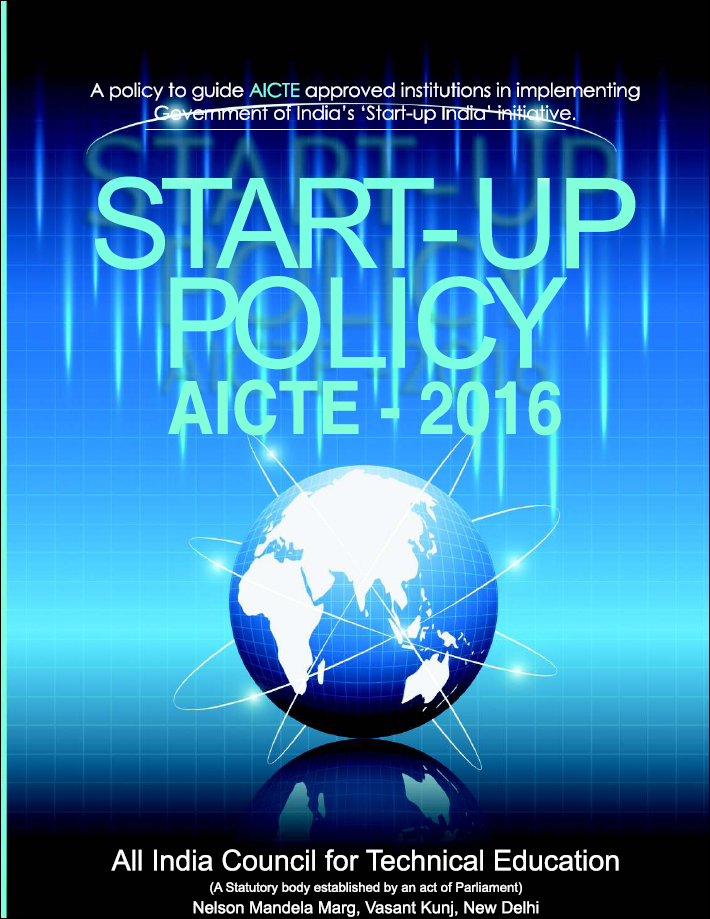
Wednesday, December 7, 2016

Indian "National Student Startup Policy" 2016 is launched

National Student Startup Policy 2016
by All India Council for Technical Education (AICTE), 2016.

About the Policy
The President of India, Shri Pranab Mukherjee launched the National Student Startup Policy on November 16, 2016 at Rashtrapati Bhavan. The National Student Startup Policy, formulated by AICTE, aims to create 100,000 technology based student start-ups and a million employment opportunities within the next 10 years. The policy plans on achieving this by developing an ideal entrepreneurial ecosystem and promoting strong inter-institutional partnerships among technical institutions. It emphasizes the much-desired need for an appropriate startup policy to propel the youth of India through and beyond the 21st century.

1. The Preamble:
An analysis of Indian entrepreneur profiles reveals that 32 years is the average age of entrepreneurs and that only 6 percent of them are women. Interestingly enough, the majority of start-up entrepreneurs in the country have a background in MNCs (multinationals) and Indian tech companies (35 percent and 27 percent respectively, from a sample of the report). Only 13 percent of start-up founders have absolutely no experience in the field before launching their ventures (NASSCOM Report). 
Student (owned) start-ups have started to contribute towards market expansion and job creation. Most of the student (owned) start-ups have evolved from technology courses instead of other liberal studies or social sciences disciplines. In recent years, a few technological and entrepreneurship development institutions have initiated efforts to design Start-up Policies for student ventures on their campuses.
AICTE took up the task of designing the 'Start-up Policy for AICTE Approved Institutions' to increase the efforts of institutions as they prepare students for entrepreneurship. AICTE's Start-up Policy would outline roles of the AICTE, Academic Institutions, and TBI (Technology Business Incubators) in creating student entrepreneurs. 

2. Vision:
To create 100,000 tech-based start-ups (student owned) and a million employment opportunities within the next 10 years (2025). This would be done by developing an ideal entrepreneurial eco-system and promoting strong inter-institutional partnerships among technical institutions. 

3. Mission:
To help create a larger number of student-driven, on campus start-ups that will add to economic and social value. To achieve this, the below mentioned strategies would be applied:
- Teaching students and encouraging them to take up entrepreneurship as a preferred career choice 
- Preparing students for successful launching of their start-ups
- Re-orienting academic curriculum and pedagogy with a strong focus on Start-ups
- Developing customized teaching and training materials for start-ups and engaging them in pre-startup activities
- Capacity Building Programmes / Activities for faculty as well as trainers.
- Mentoring start-ups to become sustainable.


Tuesday, December 6, 2016

New Book | The Ethics of Invention: Technology and the Human Future | by Sheila Jasanoff

The Ethics of Invention: Technology and the Human Future
by Sheila Jasanoff. W.W. Norton & Company, 2016, 320 pages, ISBN: 9780393078992.

About the Book
We live in a world increasingly governed by technology—but to what end?
Technology rules us as much as laws do. It shapes the legal, social, and ethical environments in which we act. Every time we cross a street, drive a car, or go to the doctor, we submit to the silent power of technology. Yet, much of the time, the influence of technology on our lives goes unchallenged by citizens and our elected representatives. In The Ethics of Invention, renowned scholar Sheila Jasanoff dissects the ways in which we delegate power to technological systems and asks how we might regain control.
Our embrace of novel technological pathways, Jasanoff shows, leads to a complex interplay among technology, ethics, and human rights. Inventions like pesticides or GMOs can reduce hunger but can also cause unexpected harm to people and the environment. Often, as in the case of CFCs creating a hole in the ozone layer, it takes decades before we even realize that any damage has been done. Advances in biotechnology, from GMOs to gene editing, have given us tools to tinker with life itself, leading some to worry that human dignity and even human nature are under threat. But despite many reasons for caution, we continue to march heedlessly into ethically troubled waters.
As Jasanoff ranges across these and other themes, she challenges the common assumption that technology is an apolitical and amoral force. Technology, she masterfully demonstrates, can warp the meaning of democracy and citizenship unless we carefully consider how to direct its power rather than let ourselves be shaped by it. The Ethics of Invention makes a bold argument for a future in which societies work together—in open, democratic dialogue—to debate not only the perils but even more the promises of technology.


About the Author
Sheila Jasanoff is professor of science and technology studies at Harvard Kennedy School. She is the author of many books on technology, most recently Science and Public Reason and Designs on Nature. She lives in Cambridge, Massachusetts.

New Book | The New ABCs of Research: Achieving Breakthrough Collaborations | by Ben Shneiderman

The New ABCs of Research: Achieving Breakthrough Collaborations
by Ben Shneiderman. Oxford University Press, 2016, 336 pages, ISBN: 9780198758839.

About the Book
The problems we face in the 21st century require innovative thinking from all of us. Be it students, academics, business researchers of government policy makers. Hopes for improving our healthcare, food supply, community safety and environmental sustainability depend on the pervasive application of research solutions. 
The research heroes who take on the immense problems of our time face bigger than ever challenges, but if they adopt potent guiding principles and effective research lifecycle strategies, they can produce the advances that will enhance the lives of many people. These inspirational research leaders will break free from traditional thinking, disciplinary boundaries, and narrow aspirations. They will be bold innovators and engaged collaborators, who are ready to lead, yet open to new ideas, self-confident, yet empathetic to others.
In this book, Ben Shneiderman recognizes the unbounded nature of human creativity, the multiplicative power of teamwork, and the catalytic effects of innovation. He reports on the growing number of initiatives to promote more integrated approaches to research so as to promote the expansion of these efforts. It is meant as a guide to students and junior researchers, as well as a manifesto for senior researchers and policy makers, challenging widely-held beliefs about how applied innovations evolve and how basic breakthroughs are made, and helping to plot the course towards tomorrow's great advancements.

About the Author
Ben Shneiderman is a Distinguished University Professor in the Department of Computer Science and Founding Director (1983-2000) of the Human-Computer Interaction Laboratory at the University of Maryland. His development of user interfaces such as the highlighted clickable link for the web, small touchscreen keyboards, and information visualization concepts earned him membership in the National Academy of Engineering.

Table of Contents
Guiding Principles
1: Combining Applied and Basic Research: ABC Principle
2: Blending Science, Engineering, and Design: SED Principle Blending
Science, Engineering & Design
3: What Science Contributes: Persistence in Understanding the World
4: What Engineering Contributes: Devotion to Focused Innovations
5: What Design Contributes: Fresh Thinking to Serve Human Needs
Research Lifecycle Strategies
6: Choose Actionable Problems that Address Civic, Business & Global Priorities
7: Apply Observation, Intervention, and Controlled Experiments
8: Form Teams with Diverse Individuals & Organizations
9: Test Ideas and Prototypes with Realistic Interventions
10: Promote Adoption & Assess Impact
Making it Happen
11: Why change is hard, but possible
12: Recommendations for action

IITD Lecture "Cycles of Invention and Discovery: Rethinking the Endless Frontier" by Prof. Venkatesh Narayanamurti | 8 December

Cycles of Invention and Discovery: Rethinking the Endless Frontier

Speaker: Prof. Venkatesh Narayanamurti
Benjamin Peirce Research Professor of Technology and Public Policy at Harvard

Date: December 8, 2016 | 5:30 pm

Venue: Seminar Hall, IIT Delhi
Abstract:
In this talk I will reflect om the genesis of the Information and Communications revolution and through an analysis of the hard case of Nobel Prizes in Physics to show that the causal direction of scientific discovery and radical invention are often reversed. They often arose in a culture of so called "applications oriented research" in industrial laboratories and will use those examples to enumerate the key ingredients of highly successful R&D institutions. My views have been shaped by my own personal experiences in industrial research, U.S National Laboratories and research intensive universities. By exploring the daily micro-practices of research, I will show how distinctions between the search for knowledge and creative-problem solving break down when one pays attention to how path breaking research actually happens. I will highlight the importance of designing institutions which transcend the 'basic-applied' dichotomy and contrasting them with models of the classic but still influential report Science, The Endless Frontier. The need for new integrative institutions to address global challenges such as climate change and alternative energy sources will be discussed.

About the speaker:
Venkatesh Narayanamurti is the Benjamin Peirce Research Professor of Technology and Public Policy at Harvard. He has served on numerous advisory boards of the federal government, research universities and industry. He was formerly the John L. Armstrong Professor and Founding Dean of the School of Engineering and Applied Sciences, Professor of Physics and Dean of Physical Sciences at Harvard. From 2009 to 2015 he served as the Director of the Science, Technology and Public Policy Program at the Harvard Kennedy School. He has a Ph D in Physics from Cornell University and a Honorary DSc from Tohoku University. He is the author of more than 240 scientific papers in different areas of condensed matter and applied physics. He lectures widely on solid state, computer, and communication, and energy technologies, and on the management of science, technology and public policy. He is a fellow of the American Academy of Arts and Sciences, and an elected member of the U.S National Academy of Engineering and of the Royal Swedish Academy of Engineering Sciences. He served as the Foreign Secretary of the U.S National Academy of Engineering from 2011 to 2015.

New Book | Cycles of Invention and Discovery: Rethinking the Endless Frontier | by Venkatesh Narayanamurti & T. Odumosu.

Cycles of Invention and Discovery: Rethinking the Endless Frontier
by Venkatesh Narayanamurti and Toluwalogo Odumosu. Harvard University Press, 2016, 176 pages, ISBN: 9780674967960.

About the Book
Cycles of Invention and Discovery offers an in-depth look at the real-world practice of science and engineering. It shows how the standard categories of "basic" and "applied" have become a hindrance to the organization of the U.S. science and technology enterprise. Tracing the history of these problematic categories, Venkatesh Narayanamurti and Toluwalogo Odumosu document how historical views of policy makers and scientists have led to the construction of science as a pure ideal on the one hand and of engineering as a practical (and inherently less prestigious) activity on the other. Even today, this erroneous but still widespread distinction forces these two endeavors into separate silos, misdirects billions of dollars, and thwarts progress in science and engineering research.
The authors contrast this outmoded perspective with the lived experiences of researchers at major research laboratories. Using such Nobel Prize–winning examples as magnetic resonance imaging, the transistor, and the laser, they explore the daily micro-practices of research, showing how distinctions between the search for knowledge and creative problem solving break down when one pays attention to the ways in which pathbreaking research actually happens. By studying key contemporary research institutions, the authors highlight the importance of integrated research practices, contrasting these with models of research in the classic but still-influential report Science the Endless Frontier. Narayanamurti and Odumosu's new model of the research ecosystem underscores that discovery and invention are often two sides of the same coin that moves innovation forward.

About the Authors
Venkatesh Narayanamurti is Benjamin Peirce Research Professor of Technology and Public Policy at the Harvard John A. Paulson School of Engineering and Applied Sciences and the Harvard Kennedy School.
Toluwalogo Odumosu is Assistant Professor of Science, Technology, and Society and Assistant Professor of Electrical and Computer Engineering in the School of Engineering and Applied Science at the University of Virginia.

Table of Contents
1. Breaking Barriers, Building Bridges
2. Boundaries in Science and Engineering Research
3. The Basic/Applied Dichotomy: The Inadequacy of the Linear Model
4. The Origins of the "Basic" and "Applied" Descriptors
5. The Discovery–Invention Cycle
6. Bell Labs and the Importance of Institutional Culture
7. Designing Radically Innovative Research Institutions
8. The Need for a Radical Reformulation of S&T Policy
9. Moving Forward in Science and Technology Policy