Abstract: Ten Indian research leaders give their prescriptions, from better funding, facilities, mentoring and education to greater respect, fairness, autonomy and confidence.
Welcome to the Social Media Research @ JNU Blog!!! This Blog is created to share information, knowledge networking and debating on the issues related to Social Media Studies and Advanced Social Media Research. Topics to be covered in this blog are (but not limited to): Mass Media, Social Media, New Media, Broadcasting, Print Media, Educational Media, Journalism, Mass Communication, Development Communication, Media Law, Media Literacy, ICT for Development and other relevant areas.
Wednesday, May 13, 2015
Indian science in Nature "Research management: Priorities for science in India"
Monday, May 11, 2015
All India Essay Competition 2015, on Contributions of Ancient India to Science
All India Essay Competition, on Contributions of Ancient India to Science
Guidelines
i. Mathematics and Logic: What are the contributions and wisdom of ancient Indian mathematicians? Could we find in their texts, the solutions to at least some of the most current problems in mathematics? Could their works help us to understand many of the mind-boggling concepts in modern mathematics, such as 'infinity', 'imaginary numbers', 'point', 'space', etc.?
ii. Physics and Cosmology: The Vedic seers had expressed a lot about cosmos, planets, movements of atoms, gravity and many more in their ancient writings. Could their profound thoughts help us to resolve many of the modern issues in physics and cosmology, such as, what is mind and how it interacts with body? What is matter really? What is dark matter? What is dark energy? What about our planetary systems and origin of universe itself? Could Vedanta help us understand problems of modern particle physics?
iii. Life Sciences and Psychology: What are the contributions of ancient seers in areas such as, genetics, evolutionary biology, bio-informatics, biochemistry, bio-physics, neuroscience, embryology, virology, cell biology? Could their wisdom help us understand and resolve the question of life and its origin? How the Vedic seers understood our human psychology -mind and its workings? Could the concept of 'soul' still make sense in modern biology? What about the meaning and purpose of life, of which we have no clue today - could the ancient scriptures reasonably and precisely provide and define this?
Similarly, there are areas of (iv) Ethics and Virtues - India's precious heritage; (v) Engineering Sciences: Metallurgy, aerodynamics, bioengineering, computers, electronics and others; (vi) Health and Medicine (vii) Philosophy and World Religions.
- The essay could be structured into various sections. Placing content in sections reflects consolidating your viewpoints into important concepts that you wish to highlight.
- A thorough literature review will always enable students to grasp and conceptualize their ideas. Therefore, to win in an essay competition, proper justification from various literature of the concepts is mandatory.
- The essay essentially needs to have an abstract. Typically, an abstract is written after finalizing all the contents of an essay.
- Quote examples whenever they are necessary. This is true to the sense that examples always make one to comprehend difficult concepts and philosophies very easily.
- Provide original illustrations for few sections. Illustrations will enrich your presentations. These illustrations could be hand drawn and if they are taking from websites, they need to be copyright free. Plagiarism and infringement of copyright issues will be dealt very seriously by Essay Competition Committee.
- Avoid plagiarism totally. Standard Journals define plagiarism as the reuse of someone Else's prior ideas, processes, results, or words without explicitly acknowledging the original author and source. Therefore, copying material as it is from various sources such as Journals, Magazines, Books, Websites without acknowledging the sources and without any further effort to restructure the sentences is one of the most common approaches in Plagiarism. To avoid plagiarism, apart from acknowledging the source, one should construct sentences on their own. If there is difficulty in this front, approach your seniors or colleagues who are more familiar in the construction of both simple and complex sentences.
- Please note that all essays and facts mentioned there in about ancient India should be accompanied with references to the original texts. Indirect references and web references are not acceptable.
- It is recommended that you should approach a professional proof reader or an English lecturer to correct your essay for tense and grammar.
- Finally, include a conclusion section that summarizes your concepts. All entries in essay competition should be typed. No hand written entries will be allowed.
- The number of pages is limited to 8. The essay competition entry shall be submitted in both doc/docx format and pdf formats.
- The essay article shall be submitted in the specified format. The format and ready template can be down loaded from the download link below. The essay is to be submitted through Email only to <esssay.aissq@gmail.com>
- Important:
Submit your essay by email: essay.aissq@gmail.com
- Essay related queries can be mailed to:
2) Ramjee Repaka, Email: rr.aissq@gmail.com
Please remember that a fundamental purpose of writing a good essay is to enrich one's technical, creative, and communicative skills without jeopardizing ethical values.
Download
|
| ||||
| Prizes All prize winners will get an opportunity to present their essays during 9th All India Students' Conference on Science and Spiritual Quest (AISSQ) to be held on 30th October - 1st November 2015 at IIT Kharagpur, India. They will be reimbursed 3-AC to-and-fro train fares and will be given attractive prizes, medals and certificates. |
CS papers "Impact of international cooperation & science & innovation strategies on S&T output: a comparative study of India & China" & "Indian paper crosses 5000+ citations mark"
S. A. Hasan, Amit Rohilla and Rajesh Luthra
Current Science, 108(9): 1603-1607, 10 MAY 2015.
Abstract: India and China have made sizeable growth in publishing science and engineering research papers in co-authorship with international institutions and patents granted in collaboration with foreign inventors during the period 1997–2012. However, the growth in case of China is much higher in comparison to India. The pace of growth in publishing research papers in co-authorship with international and domestic institutions is more or less the same in case of China, whereas India has shown higher growth in publishing research papers in co-authorship with international institutions in comparison to those with domestic institutions. The share of India and China to research papers published in co-authorship with international institutions increased from 1.8% and 4.1% respectively, in 1997 to 3.5% and 14.7% respectively in 2012. China's share to patents granted in collaboration with foreign inventors increased from 0.94% in 1997 to 13.68% in 2012, compared to an increase of 0.56% to 7.39% in case of India. The analysis shows that China has harnessed the fruit of its international cooperation in S&T to its advantage, as reflected by significant increase in research papers co-authored with international institutions and patents granted in collaboration with foreign inventors in comparison to India.
Download: http://www.currentscience.ac.in/Volumes/108/09/1603.pdf
Indian paper crosses 5000+ citations mark
Nitin Kumar, Yatish Panwar and G. Mahesh
Current Science, 108(9): 1580, 10 MAY 2015.
Abstract: For the first time, a paper having all Indian authors has received 5000+ citations.
Download: http://www.currentscience.ac.in/Volumes/108/09/1580.pdf
Wednesday, May 6, 2015
SciDev.Net: Regional hubs, truly global science and a smoother process would improve climate reports, says Purnamita Dasgupta
Speed read
- Early interaction is needed to smooth the process of approving IPCC reports
- A UN initiative could be set up to ensure more data on developing world impacts
- The panel could also set up hubs to assess region-specific concerns
As the UN's COP 21 meeting in Paris, France, draws closer, the future of the Intergovernmental Panel on Climate Change (IPCC) is under consideration. In numerous consultations from Nairobi to Berlin, member countries and scientists are discussing what's next for the body whose scientific assessments have underpinned the UN Framework Convention on Climate Change since the late 1980s.
With scientific consensus settled on the need to limit warming to two degrees Celsius by the end of the century, there seems to be not much left in the science for observers to debate. It is the internal mechanisms that are of key interest: how the assessment process and its outcomes can best help to achieve the IPCC's overall goal of providing authoritative information.
What is the IPCC assessment worth? Most scientists, policymakers and the public seem confident that it is the most authoritative source of information on climate change, its impacts, adaptation and mitigation. Experts reach their conclusions by rigorously evaluating the available peer reviewed literature.
But of late, some IPCC report authors and readers have reflected on the need to improve the form and structure of the process, raising questions about whether there is scope for changing the prevailing processes of assessing and using this science.
Smooth the approval process
There are three key areas of concern. First, there is the issue of improving the viability of the interaction between scientists and their initial 'audience'.
I use the word audience intentionally. Those involved in the report approval process will know that the Summary for policymakers is read out line by line to representatives of the panel's member countries. This is followed by deliberations between author-scientists and member country delegates, and separately among the delegates themselves.
The outcome of this intense approval process is then released to the rest of the world. At this point, the authors are free to voice their opinions on the approved text versus what was left unapproved or modified. Does this create confusion or scepticism among second-level consumers of the science as well as authors? Or does it lead to relief that a text was agreed given that in some cases there is initially some disagreement?
No doubt, what is approved is scientifically credible. The question is whether the process can be smoother. Ideally, it needs to allow for more interaction between authors and member country delegates early on in the process — so that arriving at a final, negotiated version of a document that has taken four years to produce is not squeezed into a few exhausting days.
Add developing world literature
A second concern that resonates with many IPCC authors, and carries much weight when the text gets approved, is the need for more literature from the developing world. This has been a recurring concern. It is important not only in terms of representation — how much literature from resource-poor countries is factored in — but also in terms of relevance: the evidence base for IPCC reports includes much less material covering issues unique to the developing world. For instance, there is limited literature available on climate impacts on peri-urban areas (areas surrounding a city), an increasingly important phenomenon in much of the developing world.
Empirical evidence from different parts of the world can substantiate experiences documented in particular regions. It can also reveal differences between developed and developing countries. But if literature from certain regions is scant, this can become a blind spot where some phenomenon or policy is overlooked when in fact there is just not enough evidence to judge its significance.
The situation is gradually improving. But catching up will take too long — the rate of progress is slow, and the gap is still wide. For instance, last year's Fifth assessment report considered 10,544 sources of scientific literature for Europe and 2,982 for Africa to attribute climate change impacts across different parts of the world. [1] To speed things up, an international, institutional mechanism — perhaps a UN initiative — could be set up to facilitate the process.
More inclusion of peer-reviewed science from, and based on, the developing world would lend credibility and acceptability to the evidence. It would also increase global scientific buy-in and accord the process greater transparency.
Improve reports' user friendliness
The third concern is about making the reports more user friendly through different means of presentation, outreach and dissemination. A lot of effort goes into summarising the key messages of the Synthesis report of the overall assessment in a format and language that are relatively easy for policymakers to understand. There is scope for individual assessment reports, which are written in technical language, to get similar treatment.
In a similar vein, the IPCC could set up hubs to assess region-specific concerns. One hub could be on knowledge transfer for renewable energy in South Asia; another could tackle heat-stress related adaptation in Europe. The onus for dissemination would also then lie with the regional hubs, which can best judge what is required, such as translation into local languages.
There will always be a case for having one major IPCC report — an encyclopedia of information that assesses all opportunities for mitigation and adaptation, all new progress, and the knowledge gaps and challenges that remain. There is no substitute for this since climate change is a multiscale and multidimensional issue; involves multiple disciplines across the social and natural sciences; and is relevant to a wide range of discerning stakeholders from academics to activists to policymakers.
But parallel sub-reports and an emphasis on regional hubs will open up innovative thinking and ensure the timely availability of new knowledge, particularly in rapidly changing areas such as the commercialisation of renewable energy technologies. This will not only help countries to put climate policies in place, but also to dovetail these into developmental goals and aspirations.
Purnamita Dasgupta is Acting Head in the Environmental and Resource Economics Unit at the Institute of Economic Growth in Delhi, India, and coordinating lead author of IPCC Working Group II and its Summary for policymakers, and a member of the core writing team for the Synthesis report. She can be contacted at pdg@iegindia.org
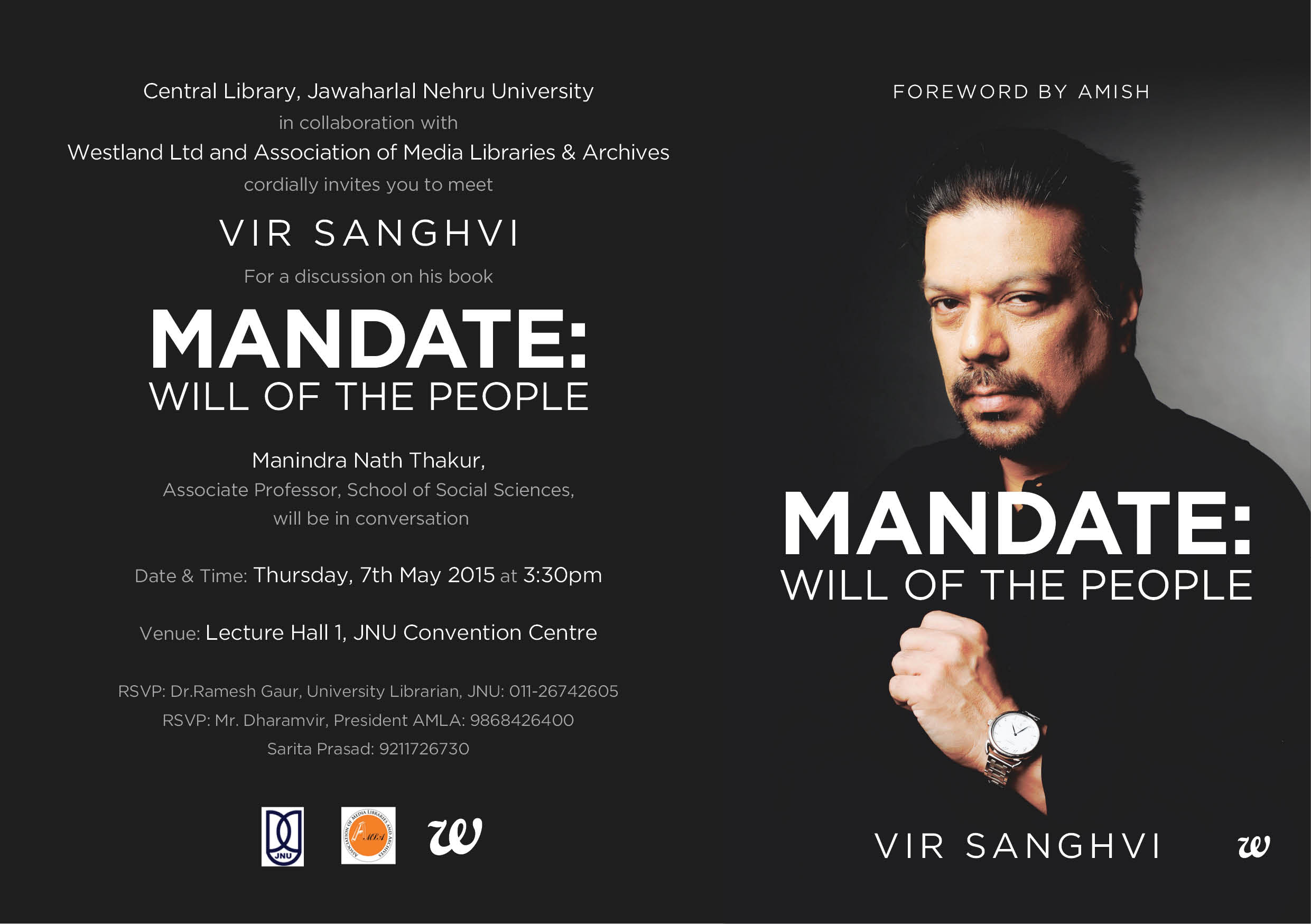
Meet the Author of "Mandate: Will of the People" Vir Sanghvi on 7th May; at 3:30pm; JNU Convention Centre
Meet the Author of "Mandate: Will of the People" Dr. Vir Sanghvi on 7th May 2015
United Nations UNCTAD releases report "Science, Technology and Innovation for Sustainable Urbanization"
In recent years, sustainable urbanization has become a very popular topic. Several conferences at international, regional and local levels have periodically discussed urbanization issues in detail. Debate on the topic has already reached a level of maturity whereby tools, resources and applications are abundant worldwide. Innovation on sustainable urbanization is happening everywhere, in both developed and developing countries.
This report aims to contribute to the sustainable urbanization discourse by addressing the specific role of science, technology and innovation. It is based on literature review and an analysis of cities in developed and developing countries that provide examples that can be reapplied elsewhere.
The report provides a fresh perspective on the discussion on sustainable urbanization, drawing on current research and case studies from around the world. The report identifies key sectoral planning challenges posed by rapid urbanization, particularly in developing countries, and proposes practical guidelines to city planners and other decision makers for addressing these challenges through the use of science, technology and innovation.
New 8-point policy plan on Sustainable Urban Waste Management in India [a new blog post]
[Apologies for cross-posting]
Sustainable Urban Waste Management in India
Posted on 5 May 2015 by Fiona Marshall
On 5th May 2015 in Delhi government officials, representatives of waste pickers associations, NGOs, industries and resident welfare associations participated in the launch event for our new policy brief on Rethinking urban waste management in India. This is just one of the outputs from a joint venture between the STEPS Centre, Jawaharlal Nehru University and the Delhi-based NGO Toxics Link as part of our sustainable urbanisation initiative. We propose a rethinking of urban waste management through a sustainability lens which embraces the informal sector and brings together environmental protection and social justice agendas, which are often seen as divergent.
The event coincides with the recent release of amended national waste management guidelines, which we have been seeking to influence as part of our environmental health in transitional spaces project. In this work we have been examining how different interest groups frame urban waste management challenges, and how this links to understandings of sustainability, complexity, risk and uncertainty and priorities for intervention. We have been exploring how and why particular waste management options (such as those that focus on waste to energy technology) become dominant, including the power relations and politics behind decision making processes, and the incentive schemes and partnerships that reinforce particular ways of doing things.
Working with a diverse range of stakeholders we have been promoting dialogue on the implications of current centralized waste management approaches in terms of the environment, health and social justice. We have been highlighting the winners and losers, the transfer of risks across time and space and between social groups, and the difficulties associated with the failure of participatory decision making processes, lack of accountability, simplistic understandings of material and social flows of waste, and lack of recognition of the informal sector.
We also learned from the multiple examples of alternative waste management strategies, and worked with people from some of the many excellent initiatives practicing and promoting them, to consider the ways in which these alternative waste management pathways were able to address the need to bring together the social justice, environmental and health concerns of sustainable urban waste management. Building on this collaborative work, we were able to distill a set of eight principles for rethinking urban waste management through a sustainability lens.
We think these principles could be adopted at multiple levels, but a key target for policy intervention has been the national Solid Waste Management rules. These are the guidelines formulated by the Ministry of Environment, Forests and Climate change (MoEFCC) that play a central role in determining how waste is collected, segregated, stored, processed and disposed of in Indian cities.
An earlier draft of these rules was released in 2013, but faced a Karnataka High Court's stay order for being "regressive". Alongside this court case, several groups raised objections against the rules. The STEPS Centre, through its partner Toxics Link in Delhi, submitted formal objections and organised a multi stakeholder dialogue (including the MoEFCC) to discuss the critique and alternative ways of understanding and managing waste.
We were delighted when, as a result, Satish Sinha from Toxics Link was the invited to become a part of the review committee responsible for producing the current draft rules. Much of the discussion at today's policy brief launch event will focus on discussion around the eight principles for rethinking sustainable urban management. Reflecting on the features that have been included, but also key gaps, particularly in terms of providing guidelines for implementation, appropriate forms of participation in decision making and procedures for accountability.
For example, in line with our policy brief, the new rules are moving beyond an 'environmental policy only' perspective on urban waste. National and state urban development agencies have been asked to formulate policy on solid waste management in the context of rules that need to be translated into city level waste plan by the Urban Local Bodies (ULBs) and others. Many new stakeholders have been involved in the management of urban waste and their responsibilities have been assigned, but it seems that no mechanism is suggested in the rules that integrates all the stakeholders, or considers accountability if they are not fulfilling their responsibilities.
Similarly, the role of the informal sector (waste pickers) has also been recognized in the new rules, but there is no proposal to develop guidelines to establish the involvement of waste pickers. Waste pickers associations are already coming together to offer coordinated solutions, and there are a number of promising examples of informal sector organisations being supported in constructive ways to address environmental health and livelihoods concerns – which are often seen as contradictory. For example, the movement for street hawkers to sell safe food by providing them with clean water and washing stations, instead of banning them as sellers of unhygienic food. The Street Vendors (Protection of Livelihood and Regulation of Street Vending) Act, 2014 is an outcome of this movement led by National Association of Street Vendors of India (NASVI).
It is also very encouraging to see recognition of decentralised technologies such as biomenthanation, and composting as beneficial for the processing of organic waste. The new draft rules now state that communities should be involved in waste management and promotion of decentralised processing, and there is even mention of the need to 'incentivise the sale of city compost'. This is an important issue in the current context of highly subsidized inorganic fertilisers which discourage compost purchase. We suggest that this should be taken several steps further by involvling NGOs and waste pickers unions/cooperatives in the promotion of decentralised processing, which itself should be incentivized.
The new draft rules clearly show that the policy process related to urban waste management is beginning to open up to new perspectives. Since the process for reviewing the earlier version of the rules was slightly democratized, the tone of the new rules is quite different from the usual official perspective of understanding urban waste. Inspiring local initiatives, which embrace urban complexity and diversity in India, have provided much of the basis for the interventions by the STEPS environmental health project, which through its partner Toxics Link, has contributed to shaping this new policy perspective.
The debates that follow today's launch have much potential to contribute to a wider urban sustainability discourse. They are occurring within the context of major ongoing government led initiatives on urbanization; such as the plan to create 100 'smart cities' to support economic growth and provide technological solutions to water and waste management, and The Swachh Bharat Abhiyan (clean India mission).
We argue that these types of initiatives suggest an absence of complexity in urban environments, lack an inclusive approach to urban development; and by failing to engage effectively with local partners and contexts or recognize the politics of sustainability may miss opportunities to address urgent challenges of sustainable urbanization. Our case study in rethinking urban waste management through a sustainability lens, highlights many of these issues and suggests a collaborative way forward.
Fiona Marshall is a STEPS member, Professor and Environment and Development at SPRU and convenor of the environmental health project. Pritpal Randhawa is a Senior Researcher at the Centre for Studies in Science Policy, Jawaharlal Nehru University, Delhi.